





New Brand Finance data reveals consumer goods, logistics and biosolutions underpin Denmark's most valuable brands in 2026
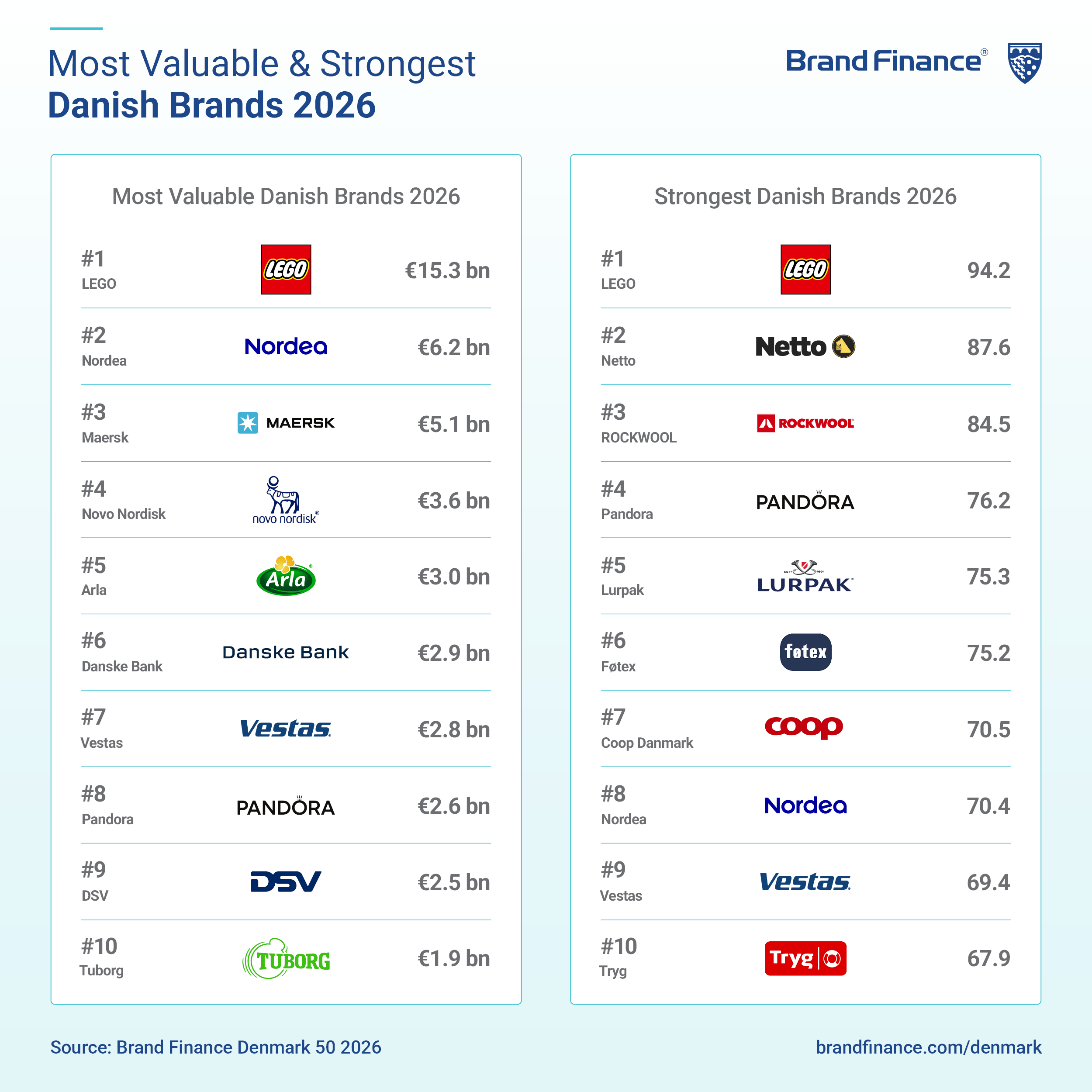
COPENHAGEN, 29 September 2026 – LEGO widens its lead among Denmark’s top brands, representing 22% of the Brand Finance Denmark 50 2026 ranking’s total brand value and posting a 54% brand value growth to EUR15.3 billion (DKK114.1 billion) this year, reflecting the country’s accelerating economy. According to Brand Finance, the world’s leading brand valuation consultancy, Denmark's top 50 brands record double-digit growth, with a 13% increase in their total brand value to EUR70.1 billion (DKK532.2 billion).
LEGO carries Denmark’s toy industry as the sector’s only featured brand in the ranking. The brand has retained its position as Denmark's most valuable brand for a decade (since 2016). The brand’s sustained performance was driven by solid financial results, reaching USD12 billion (approximately DKK77.2 billion) in revenue and an 18% surge in operating profit, as reported in March 2026. This achievement can be attributed to sustained consumer demand, a growing portfolio of innovative products, successful partnerships with global entertainment and sports franchises, and continued investment in digital and immersive brand experiences.
In addition, LEGO remains the nation’s strongest brand since 2013, receiving a Brand Strength Index (BSI) score of 94.2/100 and an AAA+ brand strength rating this year. Its unrivalled positioning within the toys sector drives strong demand for its products and reflects the loyalty of LEGO’s customer base. In early 2025, the brand announced a new multi-year brand partnership with Formula 1, driving engagement for the major sports event as well as LEGO’s latest sets from popular product lines, such as LEGO Speed Champions, LEGO Technic, and LEGO Icons. LEGO also scaled up its physical store footprint despite the growing e-commerce ecosystem, expanding beyond 1,100 locations worldwide as of mid-2026, which reinforces its brand knowledge and engagement globally.
Nordea remains Denmark’s second most valuable brand, with a 23% brand value growth to EUR6.2 billion (DKK46.3 billion). The bank’s double-digit brand value growth reflects a solid financial year, recording a total income of EUR5.9 billion in the first half of 2026. This income growth is supported by increases in net fee and commission income, corporate lending, and assets under management (AUM), which reached a value of EUR504.7 billion. The new strategy announced in November 2025 aims to see the bank shift from its reorganisation to growth, powered by continued technology enhancements. Nordea has invested in a unified digital banking platform, helping grow its digitally active users to five million.
Maersk rises one place from 2025 to become Denmark's third most valuable brand, with a 22% brand value increase to EUR5.1 billion (DKK38.2 billion). This uplift reflects the growing importance of logistics brands that are evolving beyond transportation into integrated supply chain partners. As Maersk continues its transformation from a container shipping company into an integrated logistics partner, it is increasingly using AI to strengthen customer transparency across the supply chain. Its AI-powered Trade & Tariff Studio helps customers navigate changing trade regulations by identifying tariff optimisation opportunities, assessing customs compliance risks and providing greater visibility into the impact of global policy changes before goods move.
Danske Bank is the fastest-growing Danish brand this year, following a 68% brand value growth to EUR2.9 billion (DKK21.8 billion). The banking brand also re-enters the top 10 as it climbs five spots to become the sixth most valuable brand in the ranking. Danske Bank’s brand value increase was driven by solid financial performance across its net interest income, fee income from asset management and corporate advisory, flat costs that improved its cost-to-income ratio to around 46%, and low loan losses. Globally, the brand inches closer to ranking among the top 100 most valuable banking brands after rising 34 spots to 109th place in Brand Finance’s Banking 500 2026 report.
Netto posts a brand value increase of 6% to EUR1.4 billion (DKK10.7 billion) and retains its position as the second strongest Danish brand, with a BSI score of 87.6/100 and an AAA brand strength rating. The strength of the Netto brand is driven by first-mover discount positioning, sheer physical saturation, and the distinctive “Netto dog” brand asset. Netto continues to demonstrate its commitment to value for its customers. In April 2026, Netto executed a brand-experience shift with Netto 4.0, which focuses on a more open and organised shopping experience that supports the brand’s long-term performance and future growth. The upgrades include wider aisles, improved space usage, signage, and simplified navigation to provide customers with a more comfortable shopping experience and help them find goods more easily.
Despite a 2% brand value dip to EUR597 million (DKK4.5 billion) this year, ROCKWOOL remains the third strongest brand in Denmark, receiving a BSI score of 84.5/100 and an AAA brand strength rating. In November 2025, the mineral wool manufacturer renewed its multi-year commitment to Denmark’s SailGP through to the end of 2032, reinforcing its brand presence on the world stage through a partnership that began in 2019. In addition, this renewal marks the global racing championship’s longest-running team partnership.
Mike Rocha, Chief Commercial Officer, Brand Finance, commented:
“Danish brands demonstrate the value opportunity for strong brands through sponsorship and partnership. LEGO’s multi-year partnership with Formula 1, alongside its long-running collaborations with global entertainment franchises, carries the brand well beyond the toy aisle while reinforcing the familiarity and emotional connection behind its brand strength. Meanwhile, Danske Bank’s rapid growth and ROCKWOOL’s renewed commitment to SailGP through to 2032, the championship’s longest-running team partnership, shows how a specialist manufacturer can build international visibility in a category that rarely reaches consumers directly.”




Brand Finance is the world’s leading brand valuation consultancy. Bridging the gap between marketing and finance, Brand Finance evaluates the strength of brands and quantifies their financial value to help organisations make strategic decisions.
Headquartered in London, Brand Finance operates in over 25 countries. Every year, Brand Finance conducts more than 6,000 brand valuations, supported by original market research, and publishes over 100 reports which rank brands across all sectors and countries.
Brand Finance also operates the Global Brand Equity Monitor, conducting original market research annually on 6,000 brands, surveying more than 175,000 respondents across 41 countries and 31 industry sectors. By combining perceptual data from the Global Brand Equity Monitor with data from its valuation database — the largest brand value database in the world — Brand Finance equips ambitious brand leaders with the data, analytics, and the strategic guidance they need to enhance brand and business value.
In addition to calculating brand value, Brand Finance also determines the relative strength of brands through a balanced scorecard of metrics, compliant with ISO 20671.
Brand Finance is a regulated accountancy firm and a committed leader in the standardisation of the brand valuation industry. Brand Finance was the first to be certified by independent auditors as compliant with both ISO 10668 and ISO 20671 and has received the official endorsement of the Marketing Accountability Standards Board (MASB) in the United States.
Brand is defined as a marketing-related intangible asset including, but not limited to, names, terms, signs, symbols, logos, and designs, intended to identify goods, services, or entities, creating distinctive images and associations in the minds of stakeholders, thereby generating economic benefits.
Brand strength is the efficacy of a brand’s performance on intangible measures relative to its competitors. Brand Finance evaluates brand strength in a process compliant with ISO 20671, looking at Marketing Investment, Stakeholder Equity, and the impact of those on Business Performance. The data used is derived from Brand Finance’s proprietary market research programme and from publicly available sources.
Each brand is assigned a Brand Strength Index (BSI) score out of 100, which feeds into the brand value calculation. Based on the score, each brand is assigned a corresponding Brand Rating up to AAA+ in a format similar to a credit rating.
Brand Finance calculates the values of brands in its rankings using the Royalty Relief approach – a brand valuation method compliant with the industry standards set in ISO 10668. It involves estimating the likely future revenues that are attributable to a brand by calculating a royalty rate that would be charged for its use, to arrive at a ‘brand value’ understood as a net economic benefit that a brand owner would achieve by licensing the brand in the open market.
The steps in this process are as follows:
1 Calculate brand strength using a balanced scorecard of metrics assessing Marketing Investment, Stakeholder Equity, and Business Performance. Brand strength is expressed as a Brand Strength Index (BSI) score on a scale of 0 to 100.
2 Determine royalty range for each industry, reflecting the importance of brand to purchasing decisions. In luxury, the maximum percentage is high, while in extractive industry, where goods are often commoditised, it is lower. This is done by reviewing comparable licensing agreements sourced from Brand Finance’s extensive database.
3 Calculate royalty rate. The BSI score is applied to the royalty range to arrive at a royalty rate. For example, if the royalty range in a sector is 0-5% and a brand has a BSI score of 80 out of 100, then an appropriate royalty rate for the use of this brand in the given sector will be 4%.
4 Determine brand-specific revenues by estimating a proportion of parent company revenues attributable to a brand.
5 Determine forecast revenues using a function of historic revenues, equity analyst forecasts, and economic growth rates.
6 Apply the royalty rate to the forecast revenues to derive brand revenues.
7 Discount post-tax brand revenues to a net present value which equals the brand value.
Brand Finance has produced this study with an independent and unbiased analysis. The values derived and opinions presented in this study are based on publicly available information and certain assumptions that Brand Finance used where such data was deficient or unclear. Brand Finance accepts no responsibility and will not be liable in the event that the publicly available information relied upon is subsequently found to be inaccurate. The opinions and financial analysis expressed in the study are not to be construed as providing investment or business advice. Brand Finance does not intend the study to be relied upon for any reason and excludes all liability to any body, government, or organisation.
The data presented in this study form part of Brand Finance's proprietary database, are provided for the benefit of the media, and are not to be used in part or in full for any commercial or technical purpose without written permission from Brand Finance.