





New Brand Finance data shows the sector’s collective brand value stands at $575.4 billion
MUMBAI, 23 April 2026 –India’s automobile sector has reinforced its growing global influence, with eight homegrown brands ranked among the world’s 100 most valuable and strongest names in the Automotive Industry 2026 report from Brand Finance, the world's leading brand valuation consultancy.
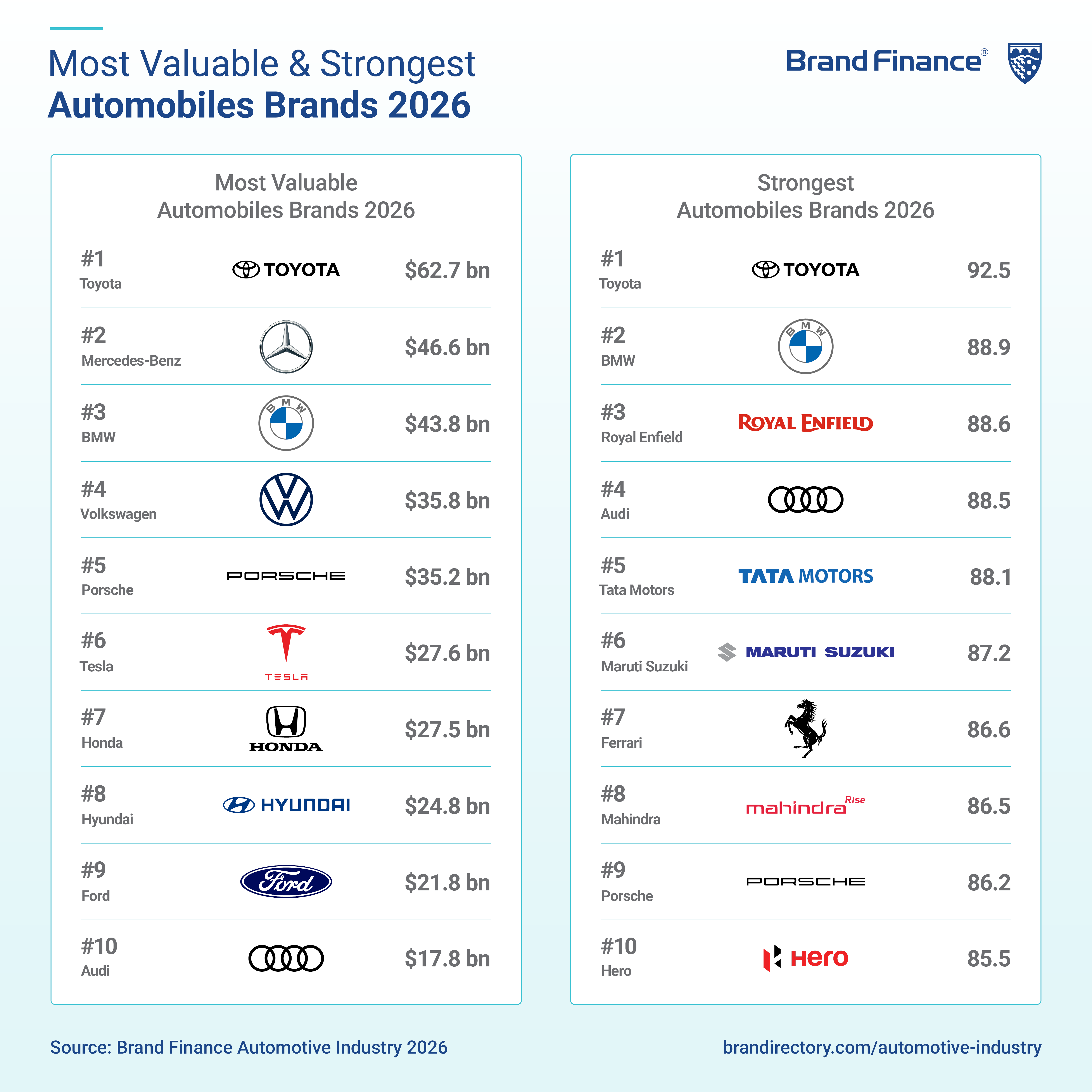
At the forefront of this success is Mahindra, which climbed to 25th rank globally in Brand Value, strengthening its position as one of India’s most valuable automotive brands. Mahindra’s brand value surged 17% year-on-year to USD3.8 billion, supported by an improved Brand Strength Index (BSI) score of 86.5/100 and an AAA brand strength rating, making it the eighth strongest automobile brand globally.
Mahindra’s rise reflects a strategy centered on SUVs, electric mobility, and distribution strength. Flagship models like the Scorpio and EV range continue to resonate with consumers, supported by strong brand equity and alignment with preferences for larger, versatile vehicles. Higher SUV margins, disciplined cost management, and platform sharing have reinforced profitability.
Looking ahead, the Born Electric platform and global partnerships are accelerating its EV roadmap, positioning Mahindra for domestic and international growth. Meanwhile, its diversified portfolio, especially tractors and farm equipment, offers a natural hedge against passenger vehicle cycles. This blend of product-led growth, rural strength, and forward-looking investments positions Mahindra to sustain momentum and outperform competitors.
Beyond Mahindra’s strong performance, several Indian brands also made notable progress in the ranking. Among its eight representatives, India now counts multiple names within the global top 10 strongest brands, a clear signal of the country’s rising influence in the automotive sector.
Royal Enfield stood out as the third strongest automobile brand, with an AAA rating and a BSI score of 88.9/100, alongside a 30% surge in brand value to USD1.2 billion. Its iconic motorcycles and lifestyle positioning continue to resonate globally.
Tata Motors (brand value at USD3.3 billion) ranks fifth among the strongest automobile brands, with a BSI score of 88.1/100 and an AAA rating. In its home market of India, the brand benefits from high familiarity and strong perceptions of credibility; however, there remains scope to strengthen consumer advocacy and improve emotional affinity to drive greater likeability. Brand Finance’s market research also shows that Tata Motors is strongly perceived across environmental, social, and governance, likely due to its EV focus.
Maruti Suzuki rose to 34th place, with its brand value up 9% to USD2.7 billion. Retaining its AAA rating and a BSI score of 87.2/100, it ranked as the sixth strongest brand worldwide, reflecting its unmatched consumer trust and reliability.
Ajimon Francis, Managing Director, Brand Finance India, commented:
“This year’s results highlight a clear shift in the global automotive landscape. Indian brands are no longer competing solely on affordability or domestic scale, they are building strong, distinctive identities with global relevance. Mahindra’s rise, alongside the strong performance of brands like Royal Enfield and Tata Motors, reflects a broader transformation driven by product innovation, growing EV ambitions, and deeper consumer trust. As these brands continue to scale internationally, India is fast establishing itself as a serious force in the global automotive sector.”
Other notable Indian brands featured in the ranking:
Together, these results highlight India’s growing stature in the global automotive landscape, not only in terms of brand value but also in brand strength, with four Indian names now counted among the world’s top 10 strongest automobile brands.




Brand Finance is the world’s leading brand valuation consultancy. Bridging the gap between marketing and finance, Brand Finance evaluates the strength of brands and quantifies their financial value to help organisations make strategic decisions.
Headquartered in London, Brand Finance operates in over 25 countries. Every year, Brand Finance conducts more than 6,000 brand valuations, supported by original market research, and publishes over 100 reports which rank brands across all sectors and countries.
Brand Finance also operates the Global Brand Equity Monitor, conducting original market research annually on 6,000 brands, surveying more than 175,000 respondents across 41 countries and 31 industry sectors. By combining perceptual data from the Global Brand Equity Monitor with data from its valuation database — the largest brand value database in the world — Brand Finance equips ambitious brand leaders with the data, analytics, and the strategic guidance they need to enhance brand and business value.
In addition to calculating brand value, Brand Finance also determines the relative strength of brands through a balanced scorecard of metrics, compliant with ISO 20671.
Brand Finance is a regulated accountancy firm and a committed leader in the standardisation of the brand valuation industry. Brand Finance was the first to be certified by independent auditors as compliant with both ISO 10668 and ISO 20671 and has received the official endorsement of the Marketing Accountability Standards Board (MASB) in the United States.
Brand is defined as a marketing-related intangible asset including, but not limited to, names, terms, signs, symbols, logos, and designs, intended to identify goods, services, or entities, creating distinctive images and associations in the minds of stakeholders, thereby generating economic benefits.
Brand strength is the efficacy of a brand’s performance on intangible measures relative to its competitors. Brand Finance evaluates brand strength in a process compliant with ISO 20671, looking at Marketing Investment, Stakeholder Equity, and the impact of those on Business Performance. The data used is derived from Brand Finance’s proprietary market research programme and from publicly available sources.
Each brand is assigned a Brand Strength Index (BSI) score out of 100, which feeds into the brand value calculation. Based on the score, each brand is assigned a corresponding Brand Rating up to AAA+ in a format similar to a credit rating.
Brand Finance calculates the values of brands in its rankings using the Royalty Relief approach – a brand valuation method compliant with the industry standards set in ISO 10668. It involves estimating the likely future revenues that are attributable to a brand by calculating a royalty rate that would be charged for its use, to arrive at a ‘brand value’ understood as a net economic benefit that a brand owner would achieve by licensing the brand in the open market.
The steps in this process are as follows:
1 Calculate brand strength using a balanced scorecard of metrics assessing Marketing Investment, Stakeholder Equity, and Business Performance. Brand strength is expressed as a Brand Strength Index (BSI) score on a scale of 0 to 100.
2 Determine royalty range for each industry, reflecting the importance of brand to purchasing decisions. In luxury, the maximum percentage is high, while in extractive industry, where goods are often commoditised, it is lower. This is done by reviewing comparable licensing agreements sourced from Brand Finance’s extensive database.
3 Calculate royalty rate. The BSI score is applied to the royalty range to arrive at a royalty rate. For example, if the royalty range in a sector is 0-5% and a brand has a BSI score of 80 out of 100, then an appropriate royalty rate for the use of this brand in the given sector will be 4%.
4 Determine brand-specific revenues by estimating a proportion of parent company revenues attributable to a brand.
5 Determine forecast revenues using a function of historic revenues, equity analyst forecasts, and economic growth rates.
6 Apply the royalty rate to the forecast revenues to derive brand revenues.
7 Discount post-tax brand revenues to a net present value which equals the brand value.
Brand Finance has produced this study with an independent and unbiased analysis. The values derived and opinions presented in this study are based on publicly available information and certain assumptions that Brand Finance used where such data was deficient or unclear. Brand Finance accepts no responsibility and will not be liable in the event that the publicly available information relied upon is subsequently found to be inaccurate. The opinions and financial analysis expressed in the study are not to be construed as providing investment or business advice. Brand Finance does not intend the study to be relied upon for any reason and excludes all liability to any body, government, or organisation.
The data presented in this study form part of Brand Finance's proprietary database, are provided for the benefit of the media, and are not to be used in part or in full for any commercial or technical purpose without written permission from Brand Finance.