Brand Financeの通信ブランド150 2026レポート:日本の通信ブランド5社中3社が業界トップ20にランクイン
東京、2026年3月19日 — 世界有数のブランド評価コンサルティング会社Brand Financeによる通信ブランド150 2026レポートによると、日本の通信ブランドは世界の通信業界の総ブランド価値の10%弱を占め、今年734億米ドルに成長した。日本の通信ブランドは、米国(24%)、ドイツ(13%)、中国(10%)に次いで、世界の通信ブランド価値への第4位の貢献国としての地位を維持している。
NTTグループ(ブランド価値13%増の419億米ドル)は、業界で5番目に価値のあるブランドとしてリードしている。過去1年間、この通信大手は、最大160億米ドルの費用をかけてNTTデータの全株式を取得し、子会社を統合するという戦略的な動きを見せた。この決定により、NTTグループは成長投資を強化し、海外市場でのプレゼンスを強化し、AIサービスポートフォリオを拡大することができた。
ソフトバンク(ブランド価値2%減の136億米ドル)は、今年ブランド価値がわずかに低下したにもかかわらず、世界で12番目に価値のある通信ブランドの座を維持している。この低下は、2025年の収益予測の低下と、ソフトバンクのOpenAIへの410億米ドルの民間資金提供後の投資家の慎重姿勢を反映しており、AI業界の評価に対する懸念から撤退が見られた。
au(ブランド価値11%増の121億米ドル)は、通信業界で14番目に価値のあるブランドとしての地位を維持している。その顕著な成長は、モバイル契約と通信セグメントからの収益増加によって牽引され、auの新しいモバイルプランが日本国内で好評を博している。
日本の主要通信企業は、業界で最も強いブランドトップ100の中でも上位にランクされている。NTTグループは、ブランド強度指数(BSI)スコア79.1/100で世界ランキングの38番目に強いブランドにランクされ、au(BSIスコア71.4/100)とソフトバンク(BSIスコア65.9/100)はそれぞれ69位と92位を占めている。
Brand Finance アジア太平洋地域マネージングディレクターのアレックス・ヘイグ氏は次のようにコメントしている:
「世界ランキングに登場する日本の5つの通信ブランドのうち3つが、業界で最も価値のある20ブランドの中に入っており、今年の成長は戦略的な転換を示しています。累積ブランド価値の10%上昇を超えて、通信業界はデジタルバリューチェーンのより上位に自らを位置づけています。
NTTグループ、ソフトバンク、auの今年のパフォーマンスは、世界の通信業界における日本の存在感を反映しており、日本の通信リーダーが接続プロバイダーから、グローバルな存在感を高める戦略的デジタルインフラプレーヤーへと変化していることを示しています。」
通信ブランド150 2026に掲載されているその他の注目すべき日本の通信ブランド:
通信業界のグローバルな洞察
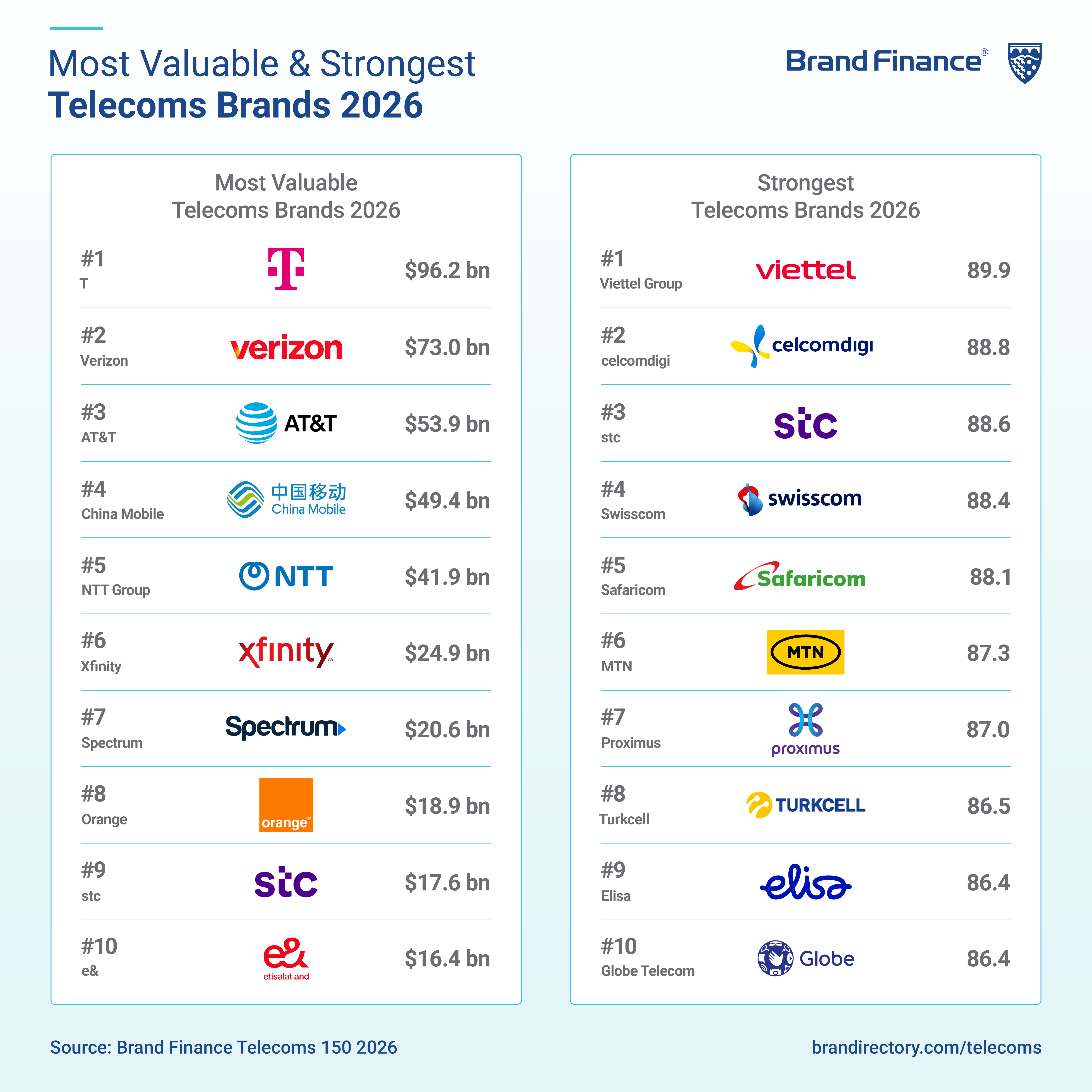
Viettel Groupが世界で最も強い通信ブランドに、Proximus、Turkcell、Elisa、Globe Telecomも最も強いトップ10リストに参入
世界トップ150の通信ブランドの総価値は2026年に7,418億米ドルに到達
Deutsche Telekomが再び世界で最も価値のある通信ブランドに、世界で最も価値のあるブランド500の中で11位にランク





Brand Finance is the world’s leading brand valuation consultancy. Bridging the gap between marketing and finance, Brand Finance evaluates the strength of brands and quantifies their financial value to help organisations make strategic decisions.
Headquartered in London, Brand Finance operates in over 25 countries. Every year, Brand Finance conducts more than 6,000 brand valuations, supported by original market research, and publishes over 100 reports which rank brands across all sectors and countries.
Brand Finance also operates the Global Brand Equity Monitor, conducting original market research annually on 6,000 brands, surveying more than 175,000 respondents across 41 countries and 31 industry sectors. By combining perceptual data from the Global Brand Equity Monitor with data from its valuation database — the largest brand value database in the world — Brand Finance equips ambitious brand leaders with the data, analytics, and the strategic guidance they need to enhance brand and business value.
In addition to calculating brand value, Brand Finance also determines the relative strength of brands through a balanced scorecard of metrics, compliant with ISO 20671.
Brand Finance is a regulated accountancy firm and a committed leader in the standardisation of the brand valuation industry. Brand Finance was the first to be certified by independent auditors as compliant with both ISO 10668 and ISO 20671 and has received the official endorsement of the Marketing Accountability Standards Board (MASB) in the United States.
Brand is defined as a marketing-related intangible asset including, but not limited to, names, terms, signs, symbols, logos, and designs, intended to identify goods, services, or entities, creating distinctive images and associations in the minds of stakeholders, thereby generating economic benefits.
Brand strength is the efficacy of a brand’s performance on intangible measures relative to its competitors. Brand Finance evaluates brand strength in a process compliant with ISO 20671, looking at Marketing Investment, Stakeholder Equity, and the impact of those on Business Performance. The data used is derived from Brand Finance’s proprietary market research programme and from publicly available sources.
Each brand is assigned a Brand Strength Index (BSI) score out of 100, which feeds into the brand value calculation. Based on the score, each brand is assigned a corresponding Brand Rating up to AAA+ in a format similar to a credit rating.
Brand Finance calculates the values of brands in its rankings using the Royalty Relief approach – a brand valuation method compliant with the industry standards set in ISO 10668. It involves estimating the likely future revenues that are attributable to a brand by calculating a royalty rate that would be charged for its use, to arrive at a ‘brand value’ understood as a net economic benefit that a brand owner would achieve by licensing the brand in the open market.
The steps in this process are as follows:
1 Calculate brand strength using a balanced scorecard of metrics assessing Marketing Investment, Stakeholder Equity, and Business Performance. Brand strength is expressed as a Brand Strength Index (BSI) score on a scale of 0 to 100.
2 Determine royalty range for each industry, reflecting the importance of brand to purchasing decisions. In luxury, the maximum percentage is high, while in extractive industry, where goods are often commoditised, it is lower. This is done by reviewing comparable licensing agreements sourced from Brand Finance’s extensive database.
3 Calculate royalty rate. The BSI score is applied to the royalty range to arrive at a royalty rate. For example, if the royalty range in a sector is 0-5% and a brand has a BSI score of 80 out of 100, then an appropriate royalty rate for the use of this brand in the given sector will be 4%.
4 Determine brand-specific revenues by estimating a proportion of parent company revenues attributable to a brand.
5 Determine forecast revenues using a function of historic revenues, equity analyst forecasts, and economic growth rates.
6 Apply the royalty rate to the forecast revenues to derive brand revenues.
7 Discount post-tax brand revenues to a net present value which equals the brand value.
Brand Finance has produced this study with an independent and unbiased analysis. The values derived and opinions presented in this study are based on publicly available information and certain assumptions that Brand Finance used where such data was deficient or unclear. Brand Finance accepts no responsibility and will not be liable in the event that the publicly available information relied upon is subsequently found to be inaccurate. The opinions and financial analysis expressed in the study are not to be construed as providing investment or business advice. Brand Finance does not intend the study to be relied upon for any reason and excludes all liability to any body, government, or organisation.
The data presented in this study form part of Brand Finance's proprietary database, are provided for the benefit of the media, and are not to be used in part or in full for any commercial or technical purpose without written permission from Brand Finance.