


Brand Finance GIFTTM 2026: global intangible value rises 32% to a record $128.4 trillion, but 87% remains undisclosed on company balance sheets
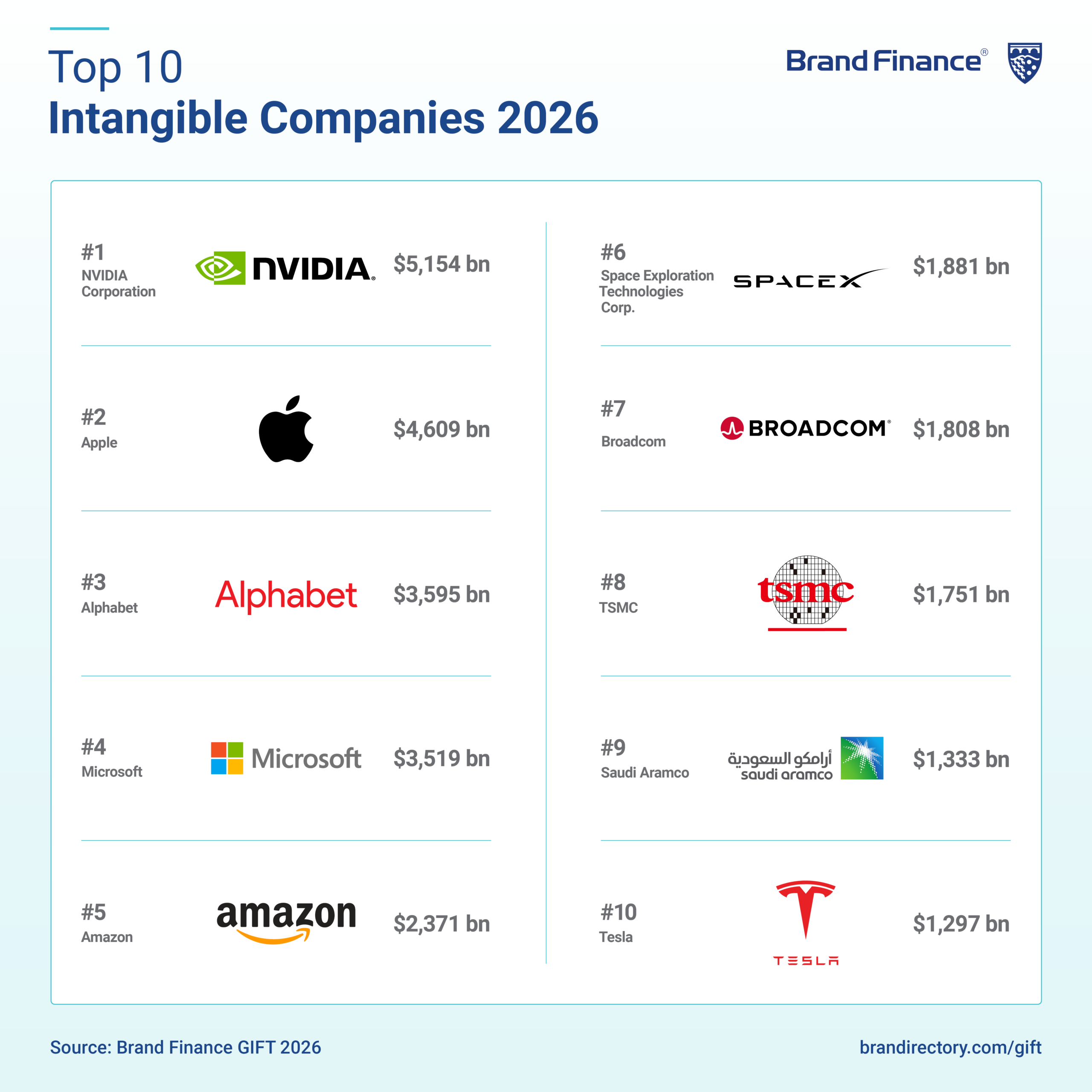
LONDON, 16 November 2026 – SpaceX has become one of the world's 10 most intangible companies in its first year as a listed business, ranking sixth globally with an estimated intangible value of USD1.9 trillion, according to a new report from Brand Finance, the world’s leading brand valuation consultancy. Yet its last annual balance sheet, for FY2025, recognised just USD13.4 billion in intangible assets and goodwill – less than 1% of that value – highlighting the growing disconnect between how companies create economic value and what conventional accounting rules allow them to recognise.
New research from Brand Finance's Global Intangible Finance Tracker (GIFT™) 2026 finds that global intangible value has risen 32% to a record USD128.4 trillion, far outpacing the 9% growth in enterprise value. Despite this, Brand Finance estimates that 87% of global intangible value remains unrecognised on company balance sheets, largely because accounting standards restrict the recognition of internally generated intangible assets.
The findings raise important questions for investors, companies and policymakers about whether financial reporting adequately reflects the assets driving modern corporate value, from brands and intellectual property to proprietary technology, data and customer relationships.
SpaceX's entry into the global top 10 illustrates the scale of the challenge. Its estimated USD1.9 trillion intangible value places it sixth globally, behind NVIDIA, Apple, Alphabet, Microsoft and Amazon. However, its last annual balance sheet before listing, for FY2025, recognised only USD13.4 billion of intangible assets and goodwill. Its quarterly accounts to 30 September 2026 show USD54.8 billion, but almost all of that increase came from the August 2026 acquisition of Cursor – value SpaceX bought rather than built.
The difference reflects a fundamental distinction in accounting treatment: identifiable intangible assets acquired through a business combination may be recognised, while many valuable assets developed internally – including brands, proprietary technology and other intellectual property – are generally not recognised as assets under current accounting standards.
Brand Finance argues that this creates an incomplete picture of corporate value, potentially making it harder for investors to assess the assets underpinning a company's market valuation.
The issue is particularly relevant for companies whose competitive advantage depends on technology, intellectual property, customer relationships and brand strength rather than physical assets.
The gap between the economic value of intangible assets and their recognition on company balance sheets has important implications for investors. When critical drivers of corporate value are not visible in reported accounts, investors may have a less complete picture of the assets underpinning a company's valuation.
SpaceX illustrates how quickly market perceptions of corporate value can change. On its first day of trading, its market value increased by approximately USD340 billion. Over the following three months, it fell by USD176 billion.
Brand Finance identified a similar reassessment of intangible value in 2025 at Novo Nordisk, where estimated intangible value fell 67% in a year as investors reassessed the company's brand strength and future drug pipeline. Neither the brand nor the internally developed pipeline was separately recognised as an asset on its balance sheet.
These examples highlight the importance of better understanding and measuring intangible assets, both for companies seeking to communicate their value and for investors assessing the risks and opportunities behind corporate valuations.
David Haigh, Chairman & CEO of Brand Finance, commented:
"SpaceX highlights a fundamental inconsistency in the way companies report their intangible assets. Under current accounting rules, the treatment of an asset can depend more on how it was created or acquired than on its economic value.
"Assets acquired through a business combination may be recognised on the balance sheet, while economically valuable assets developed internally – including technology, intellectual property and brands – are generally excluded.
"Companies should be permitted, though not required, to recognise and revalue the intangible assets they create themselves, subject to appropriate safeguards. We already have established frameworks for independently valuing assets such as property. It is time to have a more meaningful conversation about applying comparable rigour to intangible assets.
"Without better recognition and reporting, investors risk making decisions based on an incomplete picture of what companies are actually worth."
Semiconductors have overtaken Internet & Software as the sector with the highest intangible value, up 90% to USD18.3 trillion. The top 100 now includes 19 semiconductor companies, up from eight in 2025. Internet & Software intangible value fell 10% to USD9.0 trillion.
Intangible assets now account for most of the value of Greater China’s listed companies, rising from 31% in 2025 to 60% in 2026. Greater China’s total intangible value rose 85% to USD16.3 trillion, supported by growth in its semiconductor and technology companies and the July 2026 listing of CXMT.


Brand Finance is the world’s leading brand valuation consultancy. Bridging the gap between marketing and finance, Brand Finance evaluates the strength of brands and quantifies their financial value to help organisations make strategic decisions.
Headquartered in London, Brand Finance operates in over 25 countries. Every year, Brand Finance conducts more than 6,000 brand valuations, supported by original market research, and publishes over 100 reports which rank brands across all sectors and countries.
Brand Finance also operates the Global Brand Equity Monitor, conducting original market research annually on 6,000 brands, surveying more than 175,000 respondents across 41 countries and 31 industry sectors. By combining perceptual data from the Global Brand Equity Monitor with data from its valuation database — the largest brand value database in the world — Brand Finance equips ambitious brand leaders with the data, analytics, and the strategic guidance they need to enhance brand and business value.
In addition to calculating brand value, Brand Finance also determines the relative strength of brands through a balanced scorecard of metrics, compliant with ISO 20671.
Brand Finance is a regulated accountancy firm and a committed leader in the standardisation of the brand valuation industry. Brand Finance was the first to be certified by independent auditors as compliant with both ISO 10668 and ISO 20671 and has received the official endorsement of the Marketing Accountability Standards Board (MASB) in the United States.
Brand is defined as a marketing-related intangible asset including, but not limited to, names, terms, signs, symbols, logos, and designs, intended to identify goods, services, or entities, creating distinctive images and associations in the minds of stakeholders, thereby generating economic benefits.
Brand strength is the efficacy of a brand’s performance on intangible measures relative to its competitors. Brand Finance evaluates brand strength in a process compliant with ISO 20671, looking at Marketing Investment, Stakeholder Equity, and the impact of those on Business Performance. The data used is derived from Brand Finance’s proprietary market research programme and from publicly available sources.
Each brand is assigned a Brand Strength Index (BSI) score out of 100, which feeds into the brand value calculation. Based on the score, each brand is assigned a corresponding Brand Rating up to AAA+ in a format similar to a credit rating.
Brand Finance calculates the values of brands in its rankings using the Royalty Relief approach – a brand valuation method compliant with the industry standards set in ISO 10668. It involves estimating the likely future revenues that are attributable to a brand by calculating a royalty rate that would be charged for its use, to arrive at a ‘brand value’ understood as a net economic benefit that a brand owner would achieve by licensing the brand in the open market.
The steps in this process are as follows:
1 Calculate brand strength using a balanced scorecard of metrics assessing Marketing Investment, Stakeholder Equity, and Business Performance. Brand strength is expressed as a Brand Strength Index (BSI) score on a scale of 0 to 100.
2 Determine royalty range for each industry, reflecting the importance of brand to purchasing decisions. In luxury, the maximum percentage is high, while in extractive industry, where goods are often commoditised, it is lower. This is done by reviewing comparable licensing agreements sourced from Brand Finance’s extensive database.
3 Calculate royalty rate. The BSI score is applied to the royalty range to arrive at a royalty rate. For example, if the royalty range in a sector is 0-5% and a brand has a BSI score of 80 out of 100, then an appropriate royalty rate for the use of this brand in the given sector will be 4%.
4 Determine brand-specific revenues by estimating a proportion of parent company revenues attributable to a brand.
5 Determine forecast revenues using a function of historic revenues, equity analyst forecasts, and economic growth rates.
6 Apply the royalty rate to the forecast revenues to derive brand revenues.
7 Discount post-tax brand revenues to a net present value which equals the brand value.
Brand Finance has produced this study with an independent and unbiased analysis. The values derived and opinions presented in this study are based on publicly available information and certain assumptions that Brand Finance used where such data was deficient or unclear. Brand Finance accepts no responsibility and will not be liable in the event that the publicly available information relied upon is subsequently found to be inaccurate. The opinions and financial analysis expressed in the study are not to be construed as providing investment or business advice. Brand Finance does not intend the study to be relied upon for any reason and excludes all liability to any body, government, or organisation.
The data presented in this study form part of Brand Finance's proprietary database, are provided for the benefit of the media, and are not to be used in part or in full for any commercial or technical purpose without written permission from Brand Finance.
