New Brand Finance data reveals the 50 most valuable spirits brands globally are worth $161 billion, down 4% from 2025
LONDON, 8 October 2026 – Tequila brands are growing faster than any other spirits brands, according to the latest Alcoholic Drinks 2026 report by Brand Finance, the world’s leading brand valuation consultancy. José Cuervo, Don Julio and Patrón are the three fastest-growing brands in the ranking, showing tequila’s continued momentum even as the wider spirits sector faces softer demand, trade pressure and a more cautious premium consumption environment.
The total brand value of the world’s top 50 spirits brands stands at USD161 billion in 2026, down nearly 4% from 2025. The ranking shows a sector moving in two directions at once: Chinese baijiu brands continue to dominate by value, while tequila and ready-to-drink formats provide some of the strongest growth stories. At the same time, cognac, Scotch and gin brands with exposure to slower mature markets and trade disruption are among the biggest fallers.
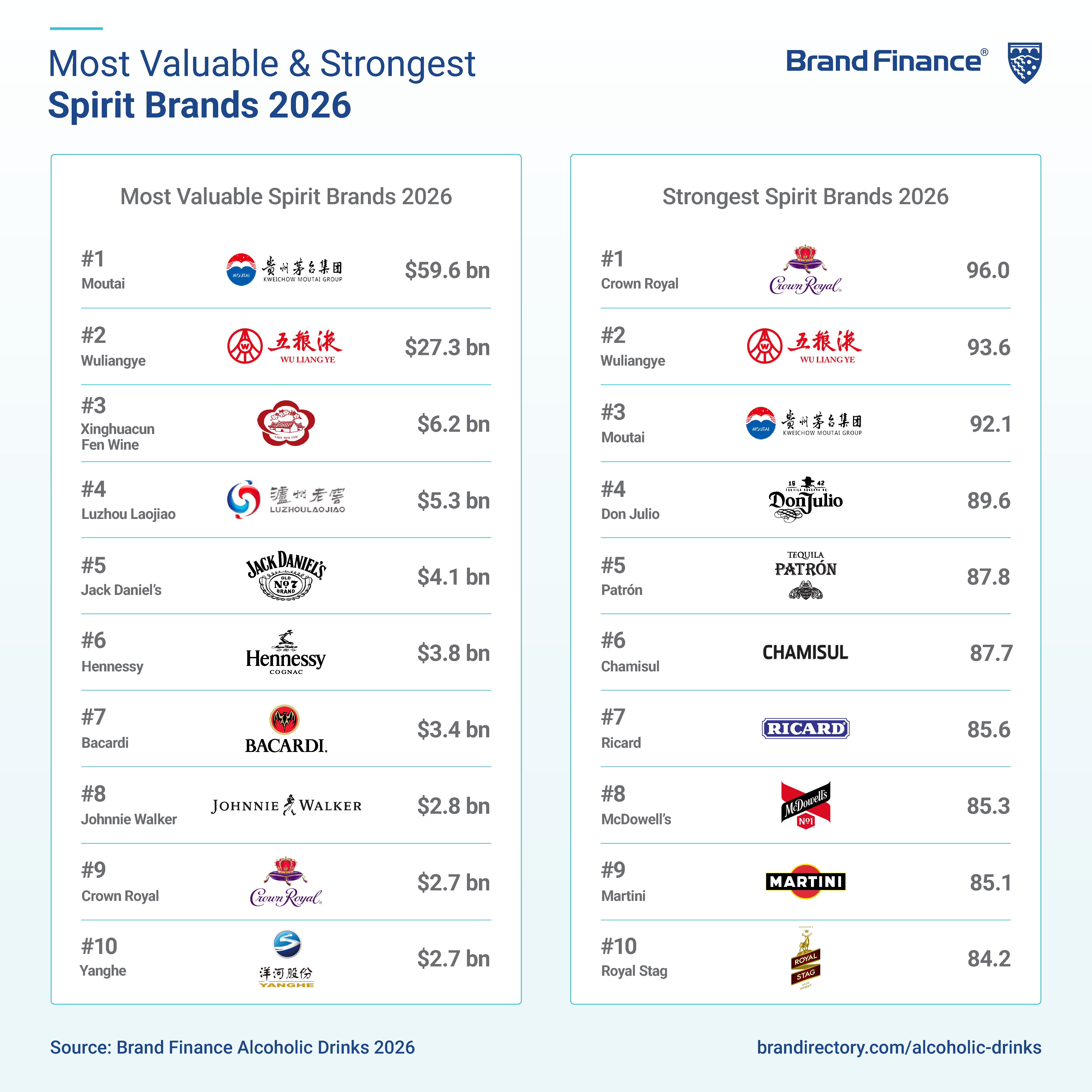
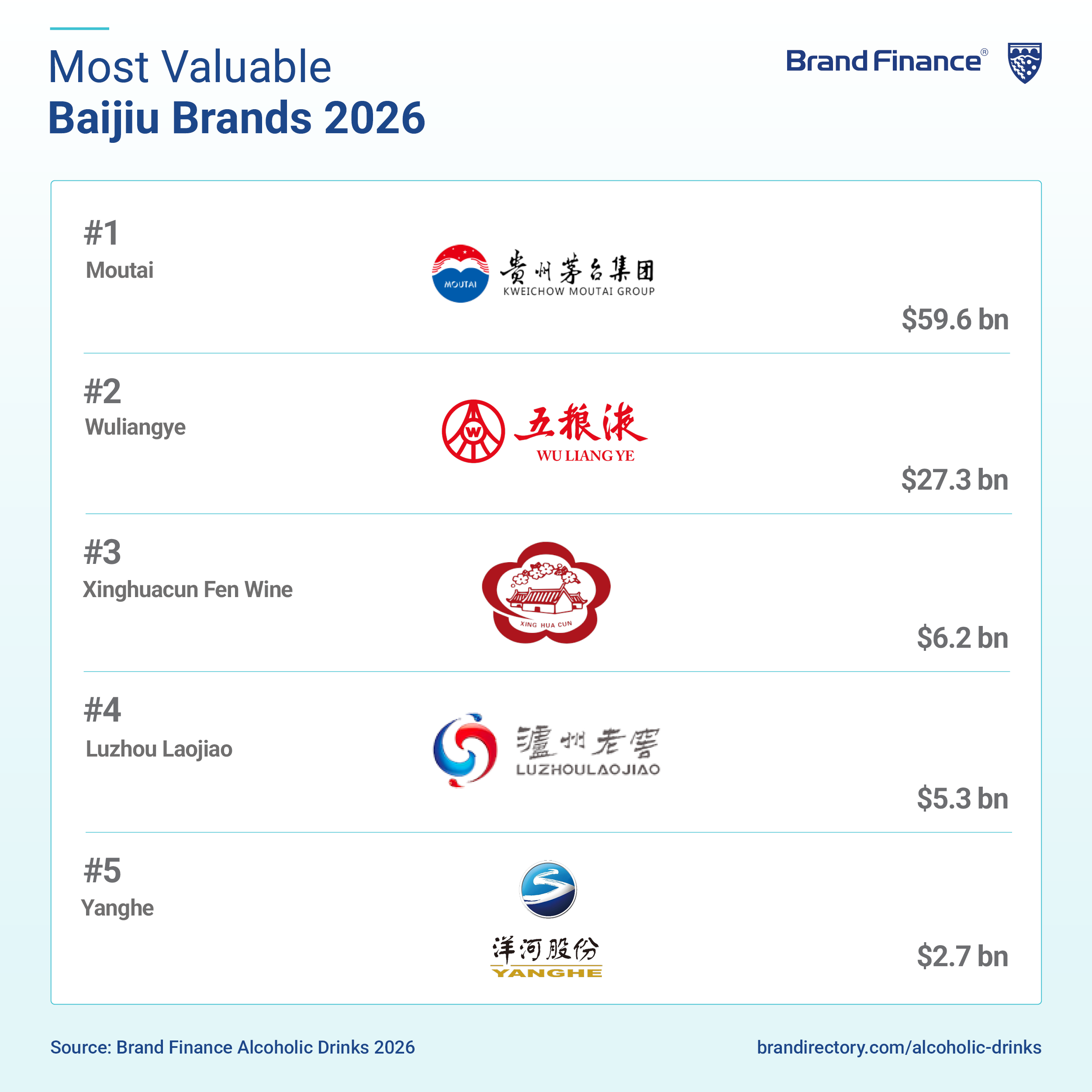
Moutai retains its position as the world’s most valuable spirits brand, with its brand value up 2% to USD59.6 billion, maintaining a commanding lead ahead of Wuliangye at USD27.3 billion. Chinese baijiu brands continue to define the top end of the ranking, but the category’s performance is increasingly divided. Xinghuacun Fen Wine rises to third place, with its brand value up 6% to USD6.2 billion, overtaking Luzhou Laojiao, which falls 16% to USD5.3 billion.
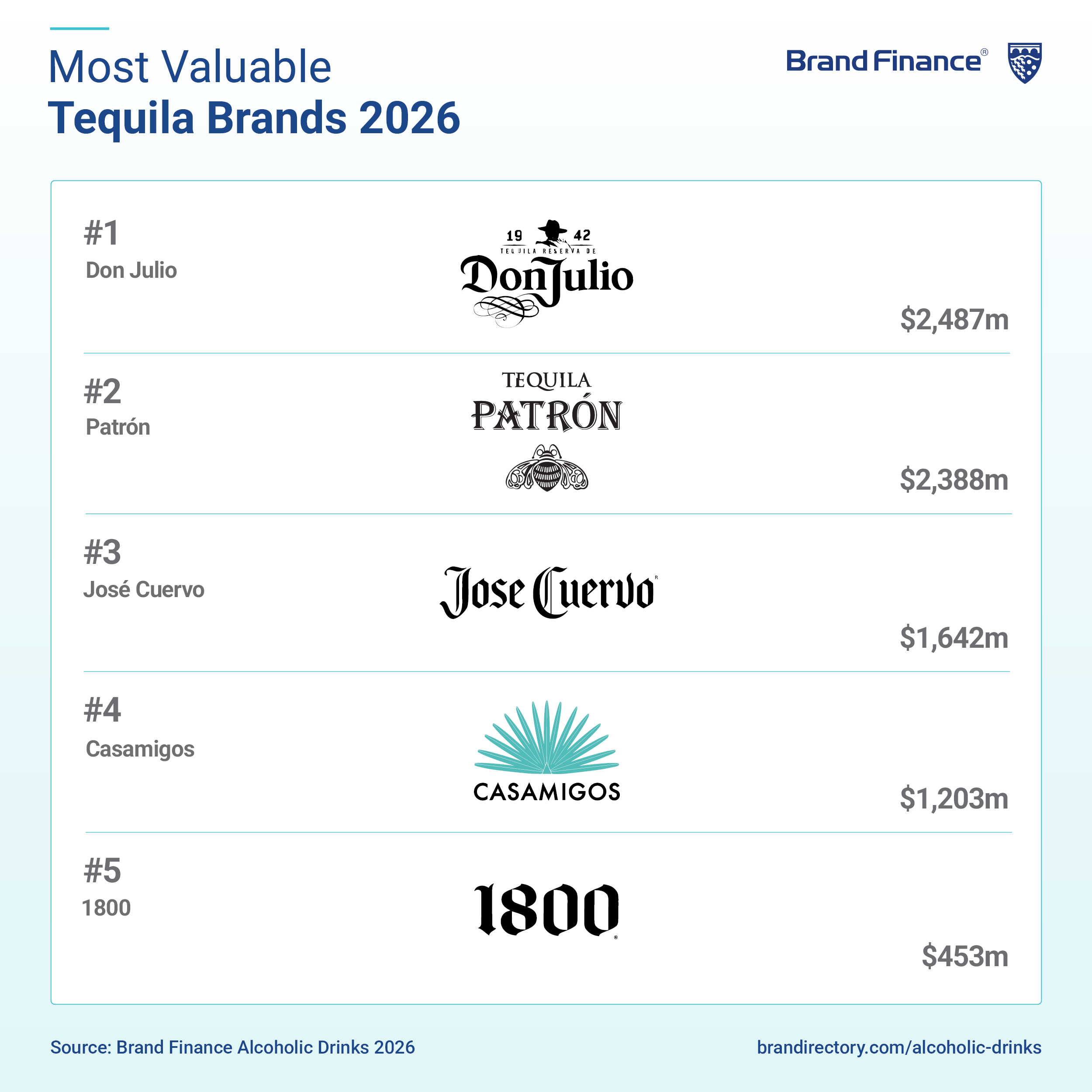
Tequila is the clearest growth story in this year’s Spirits 50 ranking. José Cuervo is the fastest-growing spirits brand overall, with its brand value rising 61% to USD1.6 billion, climbing 12 places to rank 17th. Don Julio rises 57% to USD2.5 billion, while Patrón grows 36% to USD2.4 billion. Don Julio and Patrón are now more valuable than every Scotch brand in the ranking except Johnnie Walker, reflecting tequila’s success in moving beyond party-led occasions into premium sipping, celebration and lifestyle-led consumption.
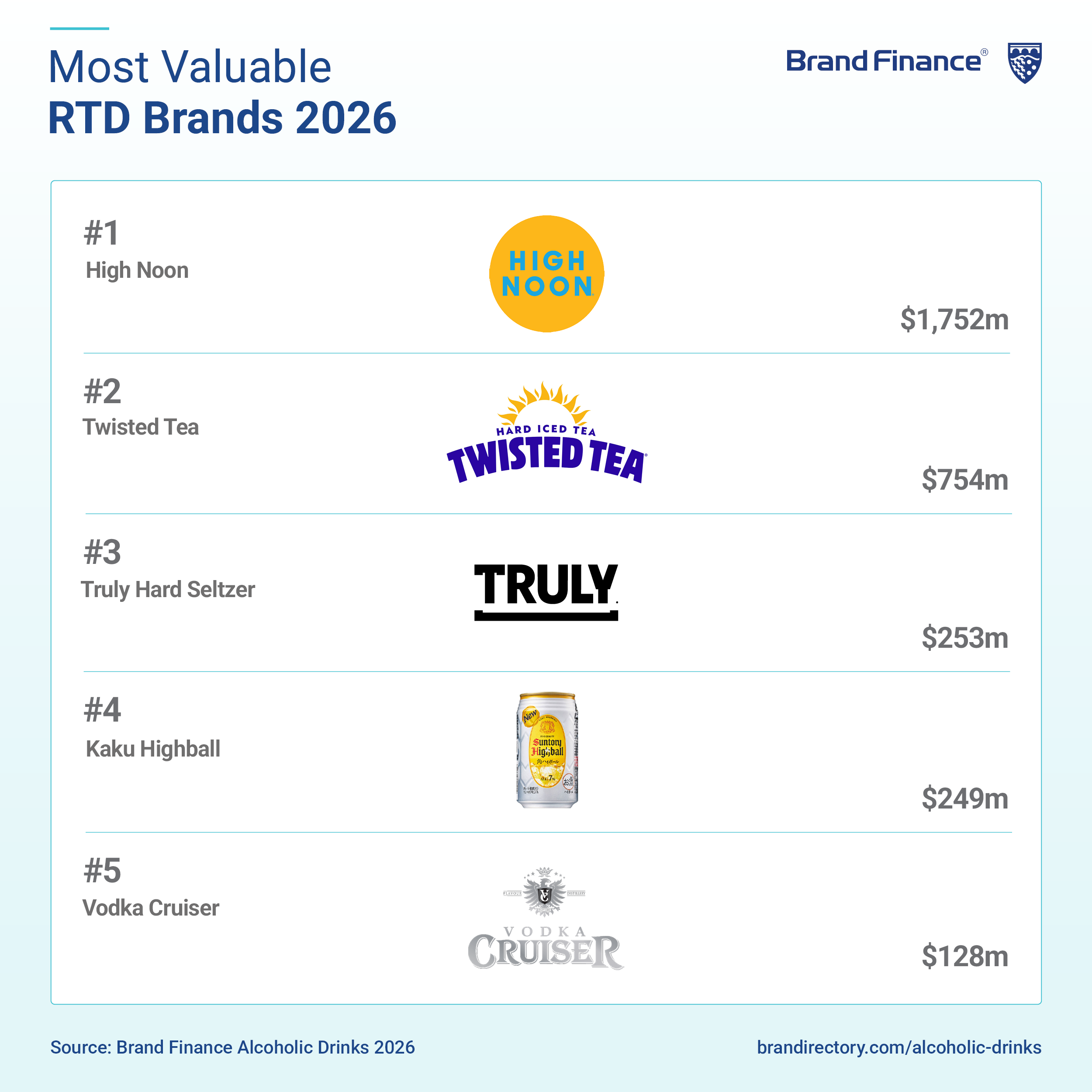
This momentum is notable because it comes despite a tougher US spirits market. The Distilled Spirits Council of the United States reported that US spirits supplier sales fell over 2% to USD36.4 billion in 2025, while spirits-based ready-to-drink cocktails remained a bright spot with over 16% sales growth. This underlines the importance of brands that can combine pricing power, loyalty, and relevance in new drinking occasions.
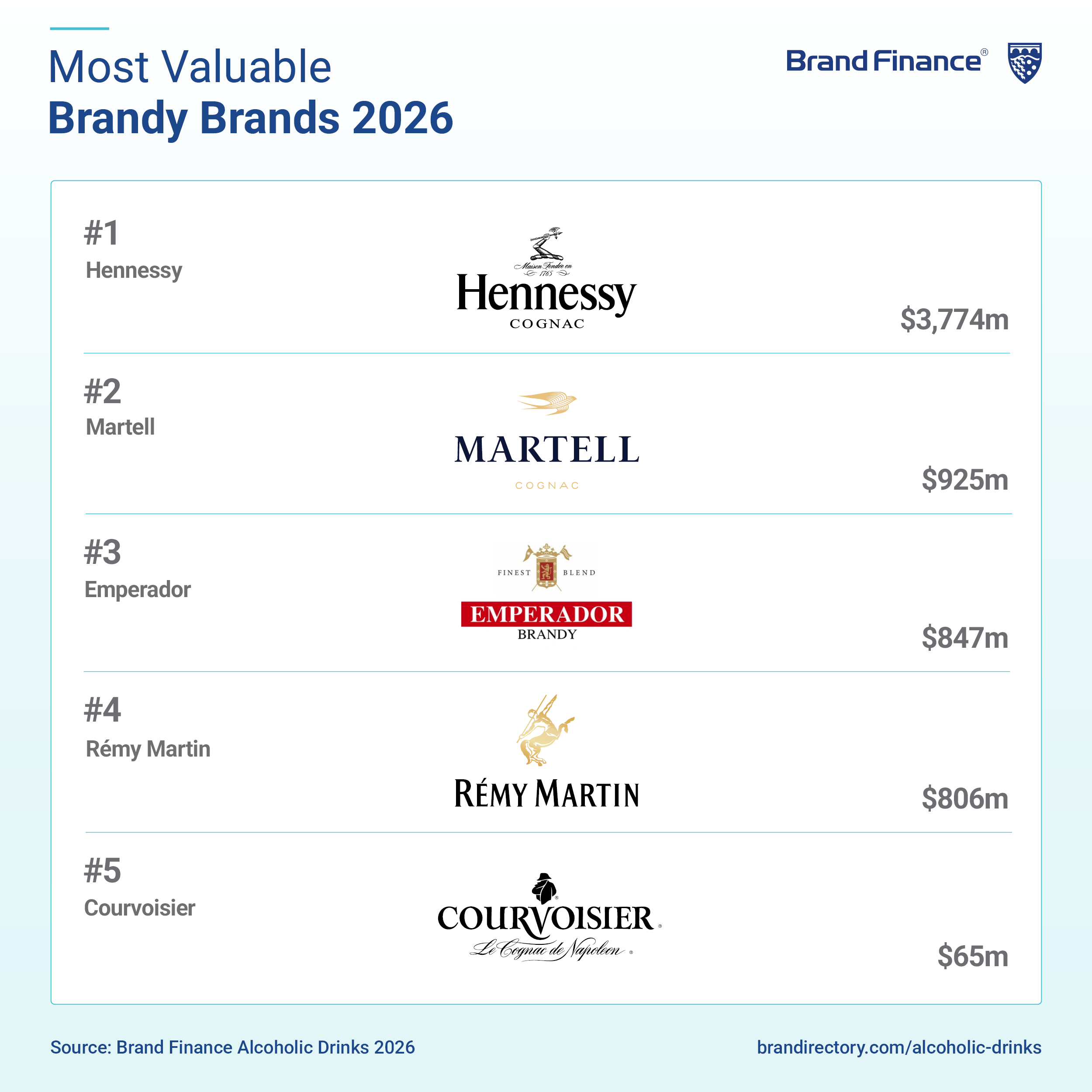
Cognac brands have faced significant pressure from trade disruption and weaker demand for premium spirits. Hennessy falls 29% to USD3.8 billion, while Rémy Martin declines 4% to USD806 million. Martell is the only cognac brand in the ranking to grow, rising 7% to USD925 million. The wider cognac category has faced pressure in its two most important markets, the US and China, where tariffs, inventory normalisation and softer high-end consumption have weighed on exports and brand performance.
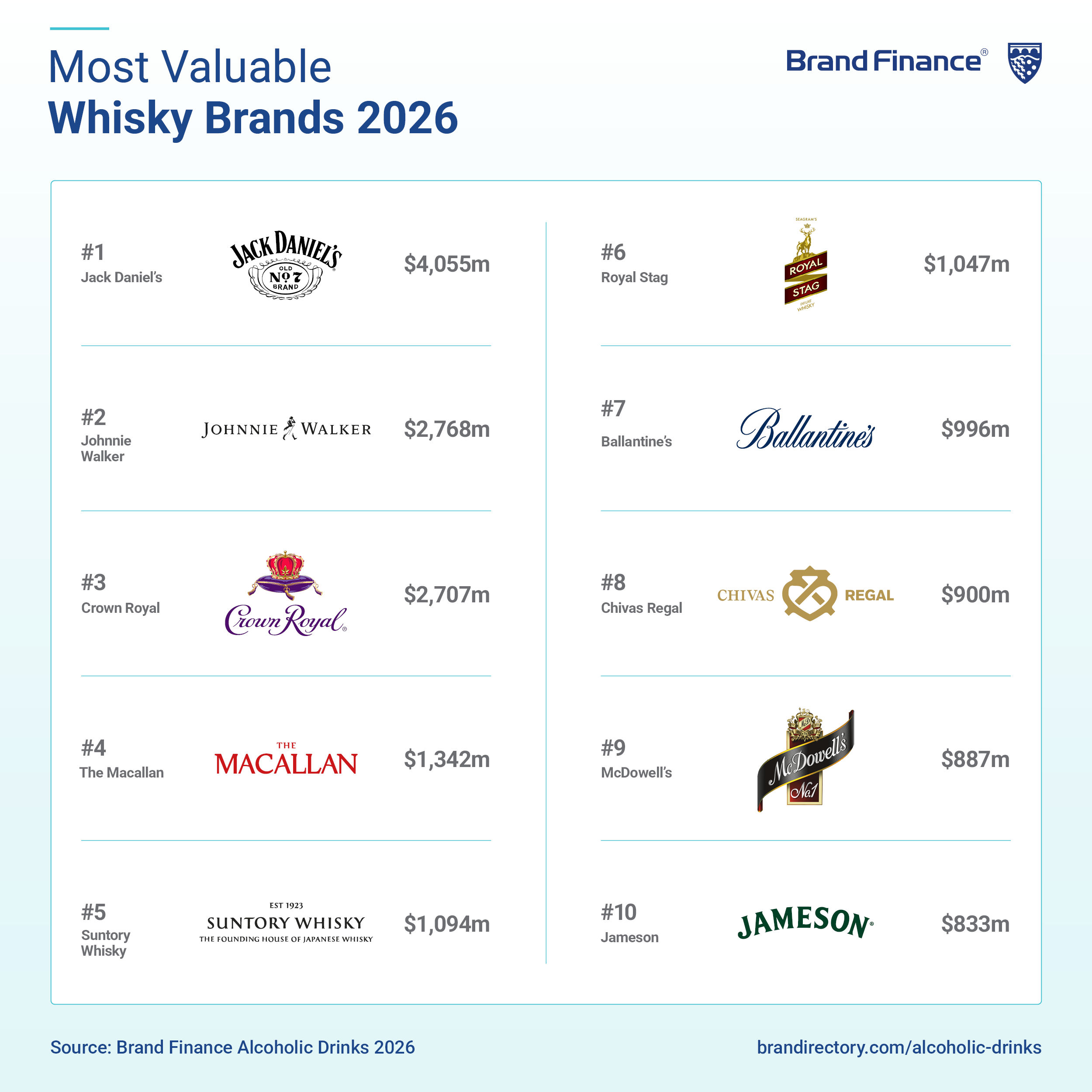
Scotch also faces a difficult backdrop. Chivas Regal is down 32% to USD900 million, and Johnnie Walker declines 10% to USD2.8 billion, while Glenfiddich is the exception, growing 13% to USD493 million. Scotch Whisky Association data shows the impact of US tariffs on Scotch exports in 2025, adding further pressure to a category already navigating softer consumer demand and higher operating costs. English whisky’s new protected status reinforces how provenance, craft, and regional authenticity are becoming more important in whisky, even as the highest-value brands remain led by established global names.
Crown Royal is the strongest spirits brand globally in 2026, achieving a Brand Strength Index (BSI) score of 96/100 and an AAA+ brand strength rating. Its brand value is up 12% to USD2.7 billion, taking it to ninth place overall. The Canadian whisky brand performs strongly on credibility and price acceptance in Brand Finance market research, while its ready-to-drink cocktails help extend the brand into casual, convenient and single-serve occasions.
Henry Farr, Global Sector Head for Alcoholic Drinks, Brand Finance, commented:
“Tariffs and softer demand have exposed spirits brands that depend heavily on one or two export markets. Cognac relies strongly on the US and China, and those are exactly the markets where trade disruption and weaker premium consumption have hit. At the same time, the leading tequila brands have continued to build pricing power and loyalty, with Don Julio and Patrón now outranking almost every Scotch brand by value. In China, baijiu is increasingly split between dominant heritage brands holding their value and a wider group losing ground.”





Brand Finance is the world’s leading brand valuation consultancy. Bridging the gap between marketing and finance, Brand Finance evaluates the strength of brands and quantifies their financial value to help organisations make strategic decisions.
Headquartered in London, Brand Finance operates in over 25 countries. Every year, Brand Finance conducts more than 6,000 brand valuations, supported by original market research, and publishes over 100 reports which rank brands across all sectors and countries.
Brand Finance also operates the Global Brand Equity Monitor, conducting original market research annually on 6,000 brands, surveying more than 175,000 respondents across 41 countries and 31 industry sectors. By combining perceptual data from the Global Brand Equity Monitor with data from its valuation database — the largest brand value database in the world — Brand Finance equips ambitious brand leaders with the data, analytics, and the strategic guidance they need to enhance brand and business value.
In addition to calculating brand value, Brand Finance also determines the relative strength of brands through a balanced scorecard of metrics, compliant with ISO 20671.
Brand Finance is a regulated accountancy firm and a committed leader in the standardisation of the brand valuation industry. Brand Finance was the first to be certified by independent auditors as compliant with both ISO 10668 and ISO 20671 and has received the official endorsement of the Marketing Accountability Standards Board (MASB) in the United States.
Brand is defined as a marketing-related intangible asset including, but not limited to, names, terms, signs, symbols, logos, and designs, intended to identify goods, services, or entities, creating distinctive images and associations in the minds of stakeholders, thereby generating economic benefits.
Brand strength is the efficacy of a brand’s performance on intangible measures relative to its competitors. Brand Finance evaluates brand strength in a process compliant with ISO 20671, looking at Marketing Investment, Stakeholder Equity, and the impact of those on Business Performance. The data used is derived from Brand Finance’s proprietary market research programme and from publicly available sources.
Each brand is assigned a Brand Strength Index (BSI) score out of 100, which feeds into the brand value calculation. Based on the score, each brand is assigned a corresponding Brand Rating up to AAA+ in a format similar to a credit rating.
Brand Finance calculates the values of brands in its rankings using the Royalty Relief approach – a brand valuation method compliant with the industry standards set in ISO 10668. It involves estimating the likely future revenues that are attributable to a brand by calculating a royalty rate that would be charged for its use, to arrive at a ‘brand value’ understood as a net economic benefit that a brand owner would achieve by licensing the brand in the open market.
The steps in this process are as follows:
1 Calculate brand strength using a balanced scorecard of metrics assessing Marketing Investment, Stakeholder Equity, and Business Performance. Brand strength is expressed as a Brand Strength Index (BSI) score on a scale of 0 to 100.
2 Determine royalty range for each industry, reflecting the importance of brand to purchasing decisions. In luxury, the maximum percentage is high, while in extractive industry, where goods are often commoditised, it is lower. This is done by reviewing comparable licensing agreements sourced from Brand Finance’s extensive database.
3 Calculate royalty rate. The BSI score is applied to the royalty range to arrive at a royalty rate. For example, if the royalty range in a sector is 0-5% and a brand has a BSI score of 80 out of 100, then an appropriate royalty rate for the use of this brand in the given sector will be 4%.
4 Determine brand-specific revenues by estimating a proportion of parent company revenues attributable to a brand.
5 Determine forecast revenues using a function of historic revenues, equity analyst forecasts, and economic growth rates.
6 Apply the royalty rate to the forecast revenues to derive brand revenues.
7 Discount post-tax brand revenues to a net present value which equals the brand value.
Brand Finance has produced this study with an independent and unbiased analysis. The values derived and opinions presented in this study are based on publicly available information and certain assumptions that Brand Finance used where such data was deficient or unclear. Brand Finance accepts no responsibility and will not be liable in the event that the publicly available information relied upon is subsequently found to be inaccurate. The opinions and financial analysis expressed in the study are not to be construed as providing investment or business advice. Brand Finance does not intend the study to be relied upon for any reason and excludes all liability to any body, government, or organisation.
The data presented in this study form part of Brand Finance's proprietary database, are provided for the benefit of the media, and are not to be used in part or in full for any commercial or technical purpose without written permission from Brand Finance.