





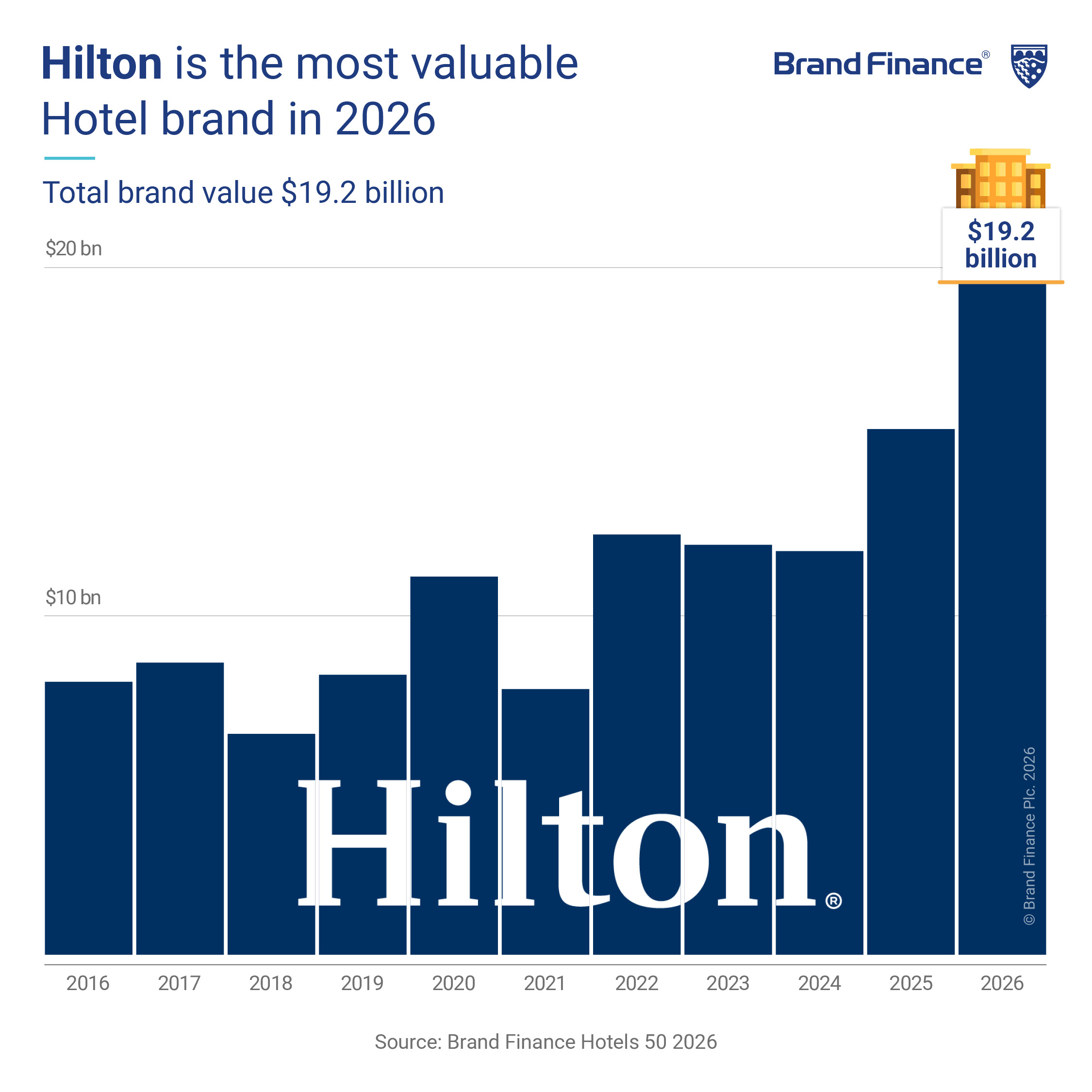
New Brand Finance data shows world's top 50 hotel brands grow 21% to $69.8 billion in 2026
BEIJING, 28 July 2026 – Three Chinese hotel brands have strengthened their global standing, led by Shangri-La, as China’s hospitality brands continue to expand their influence through brand investment, international growth, and stronger customer engagement, according to the Hotels 50 2026 report from Brand Finance, the world's leading brand valuation consultancy.
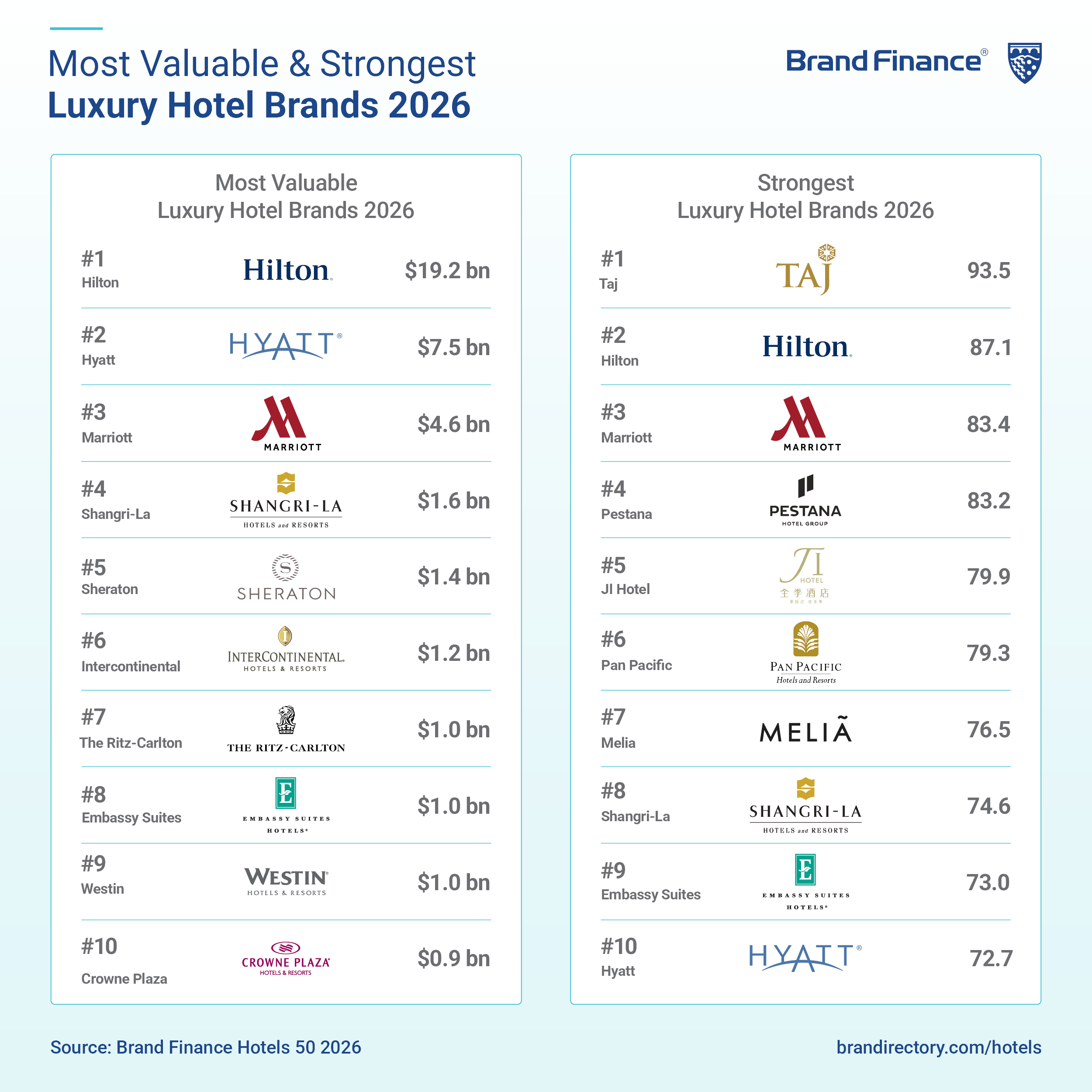
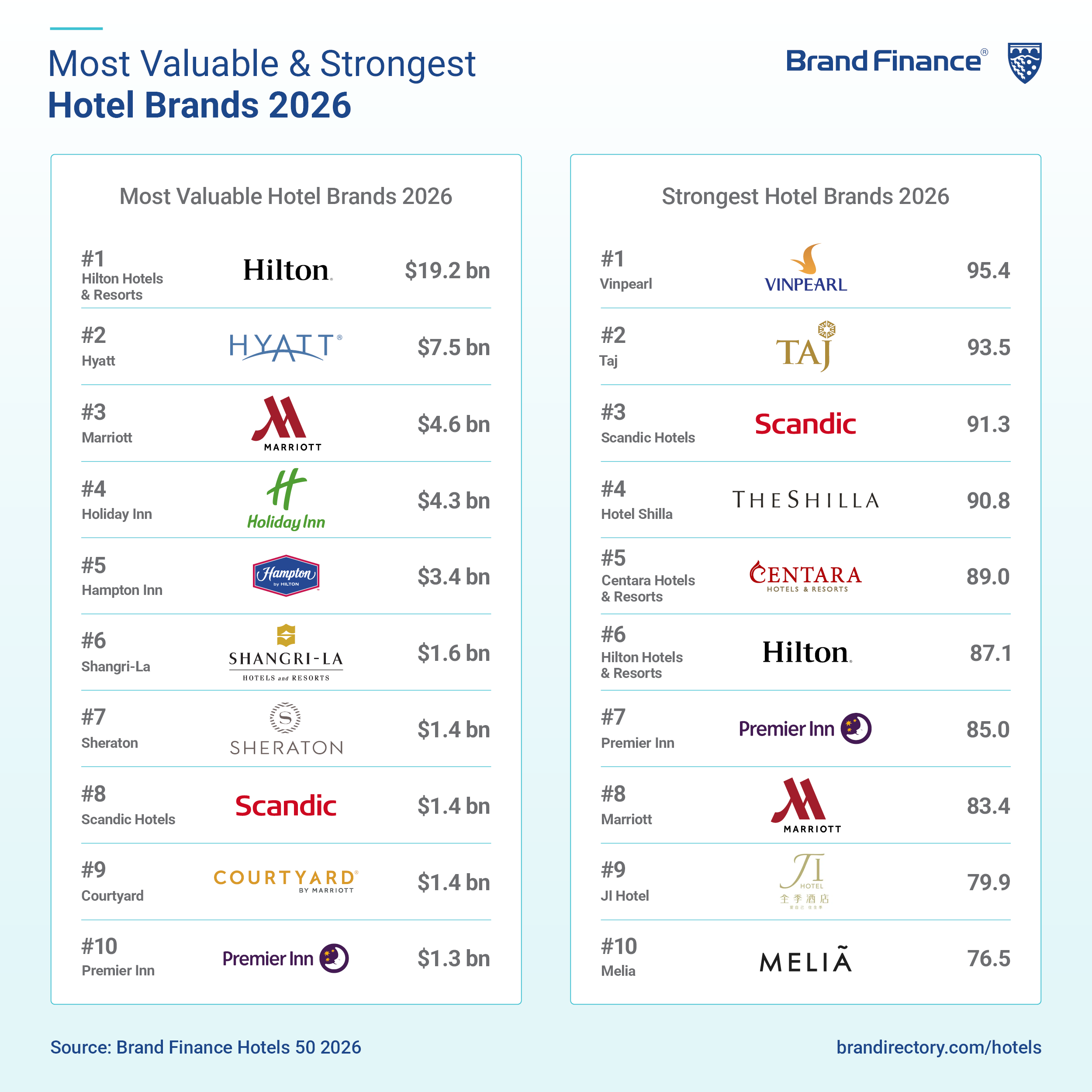
Shangri-La (brand value up 3% to USD1.6 billion) remains the highest-ranked Asian hotel brand by ranking sixth among the world’s top 10 most valuable hotel brands, reinforcing its position as a leading luxury hospitality brand globally. The brand’s growth has been supported by the launch of its ultra-luxury Shangri-La Signatures brand, expansion into new international markets, and continued efforts to diversify beyond its traditional Asia Pacific footprint. With new developments across Europe, the Middle East, and Africa, Shangri-La is strengthening its global presence while creating new opportunities to capture demand from increasingly affluent international travellers.
JI Hotel (brand value up 30% to USD550 million) recorded one of the strongest performances among Chinese hotel brands this year, climbing five places from the previous year to rank 24th among the world’s most valuable hotel brands. The brand achieved a Brand Strength Index (BSI) score of 79.9/100 and an AAA- brand strength rating, ranking as the ninth strongest hotel brand globally. Its performance reflects the continued success of its asset-light expansion model, strong domestic market positioning, and ability to deliver consistent, reliable experiences that appeal to China’s growing business and leisure travel segments.
Hanting Hotels (brand value up 27% to USD449 million) also maintains its momentum, rising four places from 2025 to rank 34th globally. The brand’s decade-long presence in the Hotels 50 rankings highlights the strength of its scalable business model and broad consumer appeal. As one of China’s largest hotel networks, Hanting continues to benefit from growing demand for affordable yet reliable accommodation, supported by its extensive domestic footprint and focus on enhancing guest experience through digitalisation and service innovation.
Scott Chen, Managing Director China, Brand Finance, commented:
"The strong performance of Chinese hotel brands in this year’s global ranking reflects the continued evolution of China’s hospitality sector from domestic scale players into globally competitive brands. Shangri-La, JI Hotel, and Hanting Hotels each demonstrate different pathways to brand growth, from luxury international expansion to scalable network development and enhanced guest experiences. As travel demand continues to recover and consumer expectations become increasingly sophisticated, brands that invest consistently in trust, service quality, and meaningful customer engagement will be best positioned to create long-term value."
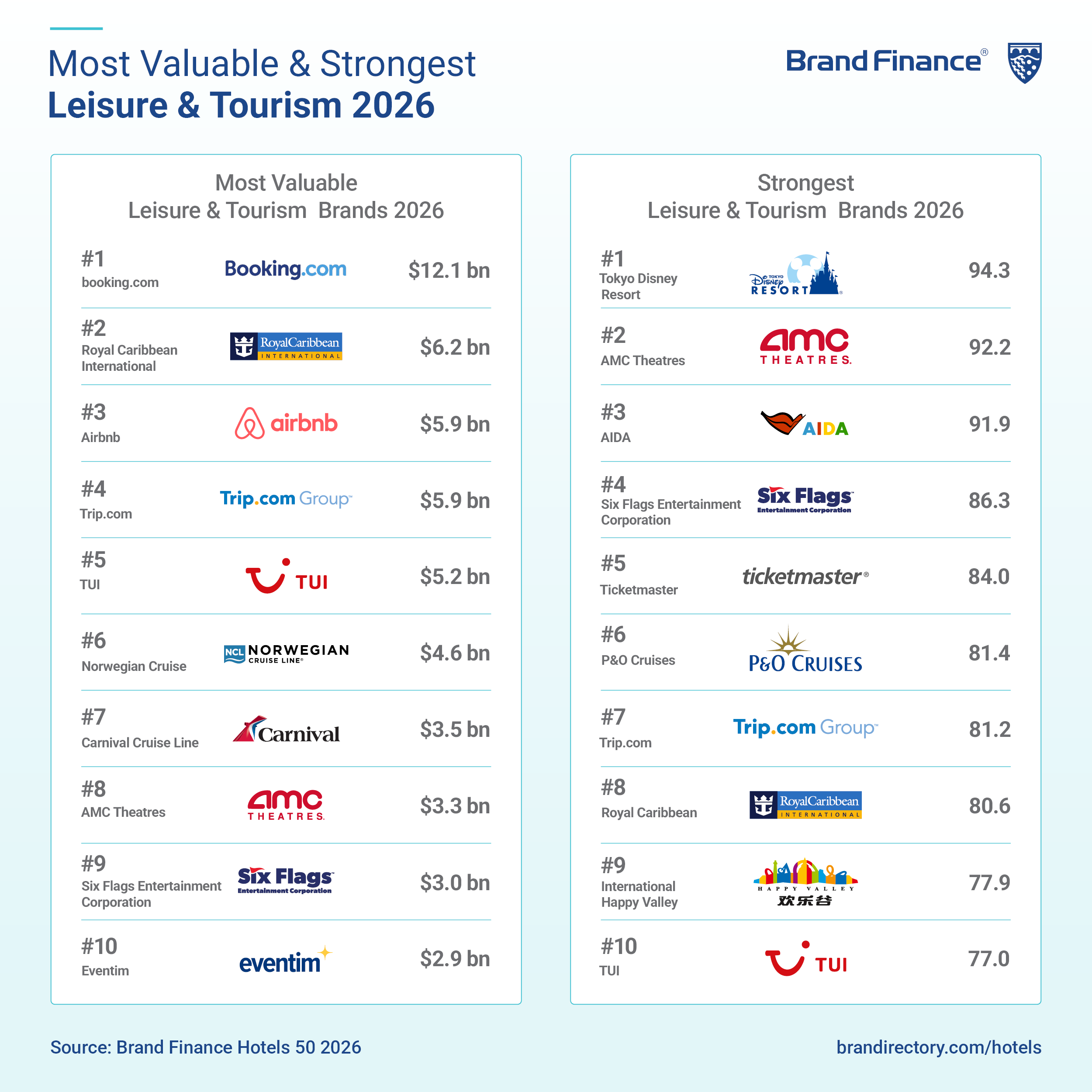
Global Hotels Standings




Brand Finance is the world’s leading brand valuation consultancy. Bridging the gap between marketing and finance, Brand Finance evaluates the strength of brands and quantifies their financial value to help organisations make strategic decisions.
Headquartered in London, Brand Finance operates in over 25 countries. Every year, Brand Finance conducts more than 6,000 brand valuations, supported by original market research, and publishes over 100 reports which rank brands across all sectors and countries.
Brand Finance also operates the Global Brand Equity Monitor, conducting original market research annually on 6,000 brands, surveying more than 175,000 respondents across 41 countries and 31 industry sectors. By combining perceptual data from the Global Brand Equity Monitor with data from its valuation database — the largest brand value database in the world — Brand Finance equips ambitious brand leaders with the data, analytics, and the strategic guidance they need to enhance brand and business value.
In addition to calculating brand value, Brand Finance also determines the relative strength of brands through a balanced scorecard of metrics, compliant with ISO 20671.
Brand Finance is a regulated accountancy firm and a committed leader in the standardisation of the brand valuation industry. Brand Finance was the first to be certified by independent auditors as compliant with both ISO 10668 and ISO 20671 and has received the official endorsement of the Marketing Accountability Standards Board (MASB) in the United States.
Brand is defined as a marketing-related intangible asset including, but not limited to, names, terms, signs, symbols, logos, and designs, intended to identify goods, services, or entities, creating distinctive images and associations in the minds of stakeholders, thereby generating economic benefits.
Brand strength is the efficacy of a brand’s performance on intangible measures relative to its competitors. Brand Finance evaluates brand strength in a process compliant with ISO 20671, looking at Marketing Investment, Stakeholder Equity, and the impact of those on Business Performance. The data used is derived from Brand Finance’s proprietary market research programme and from publicly available sources.
Each brand is assigned a Brand Strength Index (BSI) score out of 100, which feeds into the brand value calculation. Based on the score, each brand is assigned a corresponding Brand Rating up to AAA+ in a format similar to a credit rating.
Brand Finance calculates the values of brands in its rankings using the Royalty Relief approach – a brand valuation method compliant with the industry standards set in ISO 10668. It involves estimating the likely future revenues that are attributable to a brand by calculating a royalty rate that would be charged for its use, to arrive at a ‘brand value’ understood as a net economic benefit that a brand owner would achieve by licensing the brand in the open market.
The steps in this process are as follows:
1 Calculate brand strength using a balanced scorecard of metrics assessing Marketing Investment, Stakeholder Equity, and Business Performance. Brand strength is expressed as a Brand Strength Index (BSI) score on a scale of 0 to 100.
2 Determine royalty range for each industry, reflecting the importance of brand to purchasing decisions. In luxury, the maximum percentage is high, while in extractive industry, where goods are often commoditised, it is lower. This is done by reviewing comparable licensing agreements sourced from Brand Finance’s extensive database.
3 Calculate royalty rate. The BSI score is applied to the royalty range to arrive at a royalty rate. For example, if the royalty range in a sector is 0-5% and a brand has a BSI score of 80 out of 100, then an appropriate royalty rate for the use of this brand in the given sector will be 4%.
4 Determine brand-specific revenues by estimating a proportion of parent company revenues attributable to a brand.
5 Determine forecast revenues using a function of historic revenues, equity analyst forecasts, and economic growth rates.
6 Apply the royalty rate to the forecast revenues to derive brand revenues.
7 Discount post-tax brand revenues to a net present value which equals the brand value.
Brand Finance has produced this study with an independent and unbiased analysis. The values derived and opinions presented in this study are based on publicly available information and certain assumptions that Brand Finance used where such data was deficient or unclear. Brand Finance accepts no responsibility and will not be liable in the event that the publicly available information relied upon is subsequently found to be inaccurate. The opinions and financial analysis expressed in the study are not to be construed as providing investment or business advice. Brand Finance does not intend the study to be relied upon for any reason and excludes all liability to any body, government, or organisation.
The data presented in this study form part of Brand Finance's proprietary database, are provided for the benefit of the media, and are not to be used in part or in full for any commercial or technical purpose without written permission from Brand Finance.