





Brand Finance’s Logistics 50 2026 report reveals that 48% of the featured brands record double-digit growth
LONDON, 27 August 2026 – The logistics industry faces ongoing financial and geopolitical headwinds since February 2025, including tariffs imposed by the US, geopolitical tensions in the Middle East, and disrupted supply chains. According to the Logistics 50 2026 report by Brand Finance, the world’s leading brand valuation consultancy, the logistics industry recorded a brand value of USD216.8 billion amid its recovery. The US continues to be the largest contributor to total brand value, with a 42% share at USD90.8 billion. China remains the second largest, contributing a 14% share (USD30.6 billion), followed by Germany, with a 9% share (USD20.5 billion).
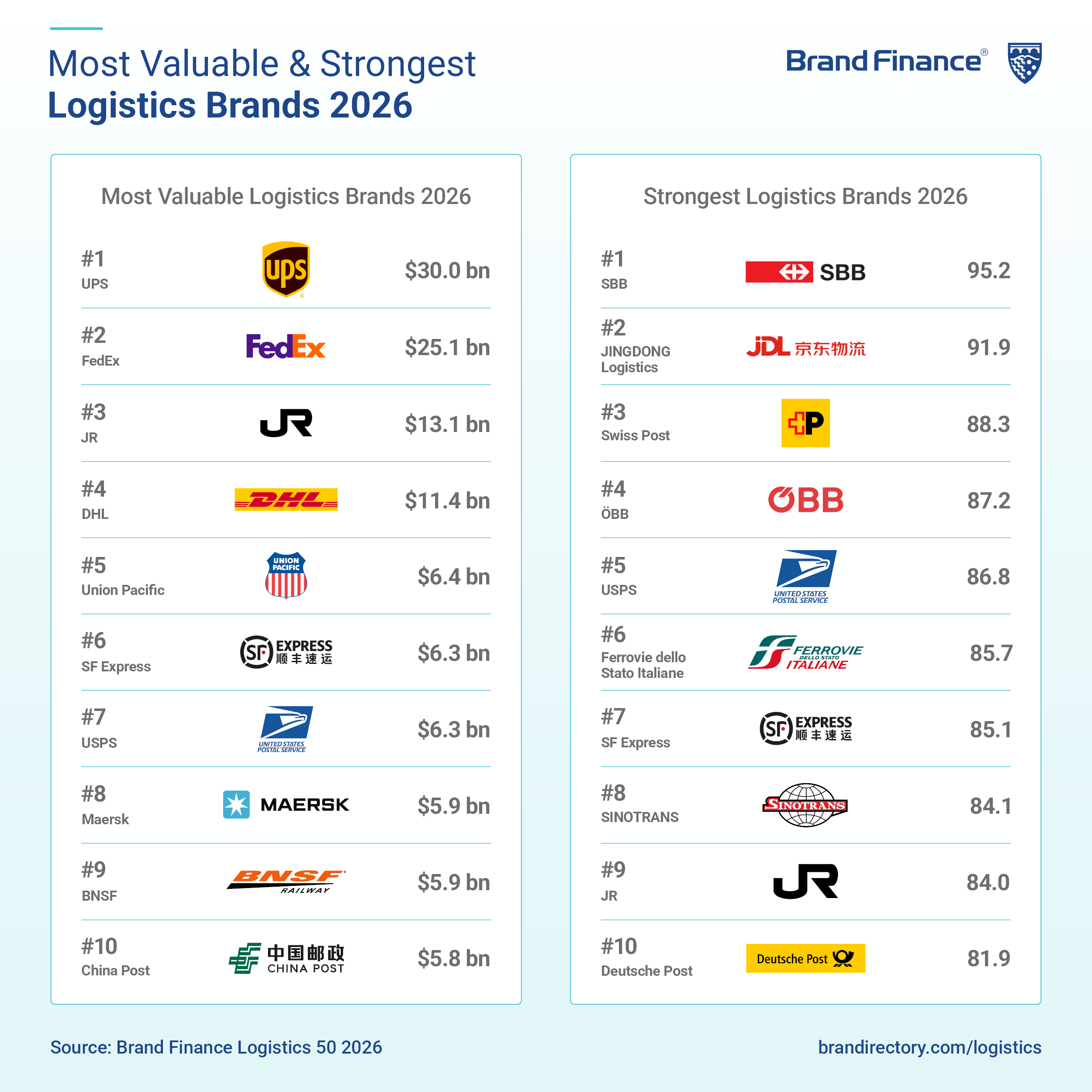
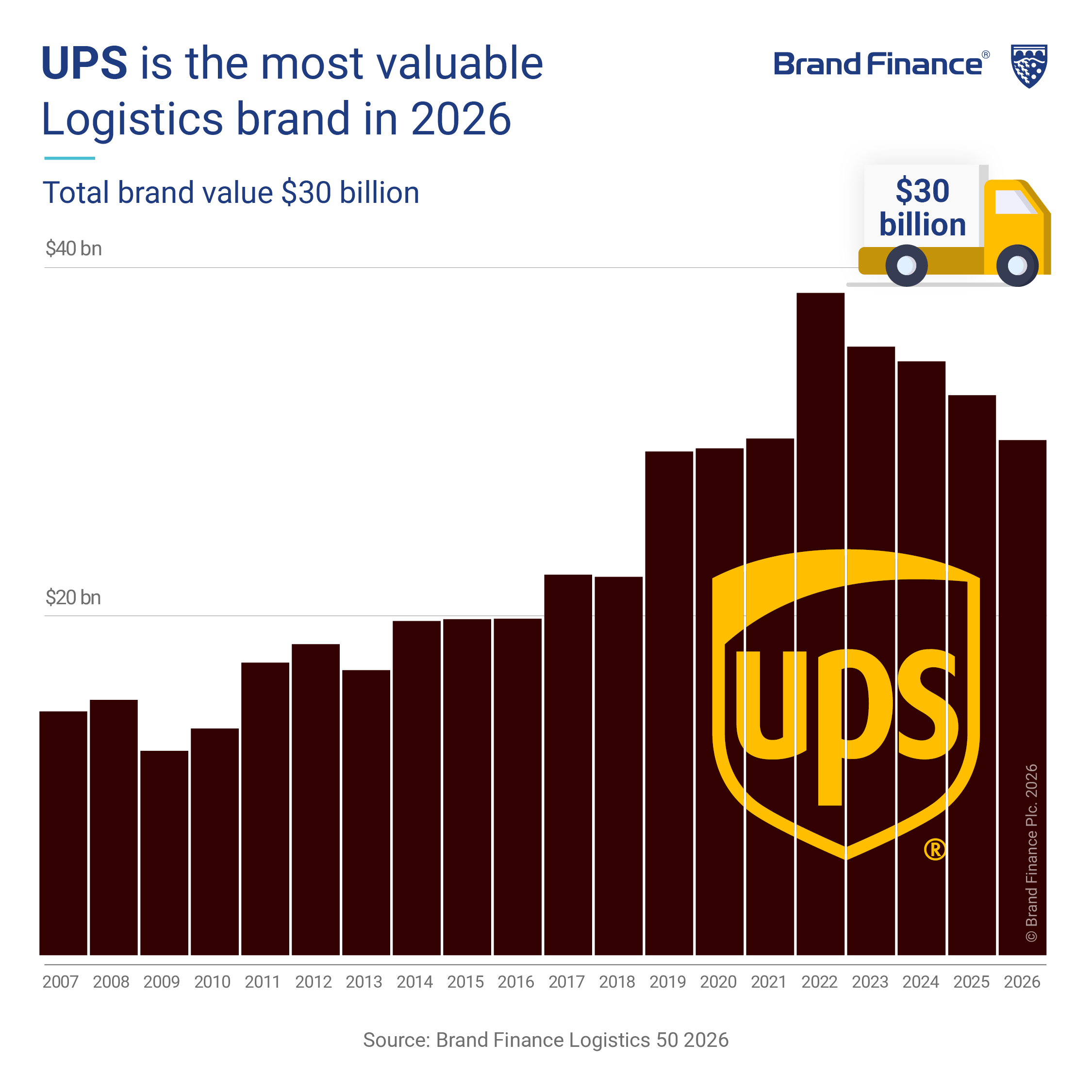
UPS (brand value down 8% to USD30 billion) remains the most valuable logistics brand for 12 years running despite a brand value dip in 2026. In January 2025, the American brand announced that it would reduce its dependency on Amazon, its largest customer of nearly 30 years, by cutting down more than 50% of Amazon’s shipments by 2026, since the shipments are high-volume but margin dilutive. Despite the partnership contributing almost 11% of UPS’s consolidated revenue, UPS aims to focus more on profitable ventures, such as healthcare logistics, which generated more than USD11 billion in the brand’s 2025 revenue.
FedEx remains the second most valuable logistics brand, recording a 10% brand value growth to USD25.1 billion. The brand’s sustained performance can be attributed to the success of its cost efficiency strategy, amid ongoing headwinds. In June 2025, the brand announced that it achieved its USD5 billion cost-reduction target and another cost-reduction target of USD1 billion in May 2026. Additionally, the brand expanded its revenue channels and solidified its position within the industry as its spin-off brand, FedEx Freight, was finalised into a new publicly traded company on 1 June 2026.
JR (brand value at USD13.1 billion) maintains its position as the third most valuable logistics brand this year. The brand demonstrates consistent performance thanks to increased revenue across its JR East, JR West, and JR Central lines. The Japanese railway’s eastern line, JR East, increased its fares for the first time in 37 years, improving its revenue forecast by JPY82 billion (approximately USD535 million). JR West, the brand’s western line, also recorded an increase in revenue for the fifth consecutive year, thanks to the World Expo 2025 in Osaka and Kansai, Japan. Meanwhile, JR Central reported an optimistic year-on-year growth in transportation revenue to JPY785.4 billion (approximately USD5.1 billion) across its Shinkansen and conventional line services.
CEVA emerges as the fastest-growing brand, with a brand value increase of 129% to USD2.1 billion. In November 2025, CEVA finalised its acquisition of Borusan Lojistik, providing the brand with a stronger presence in Turkey, consolidating its operational expertise, and establishing a foothold in a region that strategically connects Europe, the Middle East, and Asia. In April 2026, CEVA renewed its contract with Ocado Retail, the UK’s largest dedicated online supermarket, reinforcing its relationship as well as solidifying CEVA’s positioning in the UK. Within the same month, CEVA also secured a three-year contract with Hilton Food Solutions, underscoring CEVA’s capabilities in delivering integrated, port-centric logistics solutions for the food industry and reinforcing the brand as a reliable logistics partner. SBB (new entrant at USD2.6 billion) enters the Logistics 50 ranking for the first time and positions itself as the strongest logistics brand this year, with a Brand Strength Index (BSI) score of 95.2/100 and an AAA+ brand strength rating. The Swiss rail brand’s strength was supported by its “Expansion Step 2025”, a CHF5.5 billion (USD6.8 billion) programme that spans 60 projects, such as a double-track expansion in the St. Gallen Rhine Valley, a third platform in the Bellinzona-Giubiasco station, and an expansion of the rail nodal point of Bern. The programme focuses on eliminating bottlenecks, increasing capacities, and providing customers with more frequent and reliable services.
SBB (new entrant at USD2.6 billion) enters the Logistics 50 ranking for the first time and positions itself as the strongest logistics brand this year, with a Brand Strength Index (BSI) score of 95.2/100 and an AAA+ brand strength rating. The Swiss rail brand’s strength was supported by its “Expansion Step 2025”, a CHF5.5 billion (USD6.8 billion) programme that spans 60 projects, such as a double-track expansion in the St. Gallen Rhine Valley, a third platform in the Bellinzona-Giubiasco station, and an expansion of the rail nodal point of Bern. The programme focuses on eliminating bottlenecks, increasing capacities, and providing customers with more frequent and reliable services.
Alex Haigh, Global Sector Head of Logistics, Brand Finance, commented:
“This year’s logistics ranking marks a shift in where value is created in logistics. UPS’s decision to shed margin-dilutive projects in favour of healthcare logistics shows that scale alone no longer commands a premium, but the quality of the network does. FedEx’s cost discipline and CEVA’s brand value surge point in the same direction: brands are being rewarded for what they carry and how reliably, instead of simply relying on shipment volume. SBB’s arrival as the strongest brand in the sector signals that dependability has become the asset customers pay for."
Other notable brands featured in the Brand Finance Logistics 50 2026 report include:




Brand Finance is the world’s leading brand valuation consultancy. Bridging the gap between marketing and finance, Brand Finance evaluates the strength of brands and quantifies their financial value to help organisations make strategic decisions.
Headquartered in London, Brand Finance operates in over 25 countries. Every year, Brand Finance conducts more than 6,000 brand valuations, supported by original market research, and publishes over 100 reports which rank brands across all sectors and countries.
Brand Finance also operates the Global Brand Equity Monitor, conducting original market research annually on 6,000 brands, surveying more than 175,000 respondents across 41 countries and 31 industry sectors. By combining perceptual data from the Global Brand Equity Monitor with data from its valuation database — the largest brand value database in the world — Brand Finance equips ambitious brand leaders with the data, analytics, and the strategic guidance they need to enhance brand and business value.
In addition to calculating brand value, Brand Finance also determines the relative strength of brands through a balanced scorecard of metrics, compliant with ISO 20671.
Brand Finance is a regulated accountancy firm and a committed leader in the standardisation of the brand valuation industry. Brand Finance was the first to be certified by independent auditors as compliant with both ISO 10668 and ISO 20671 and has received the official endorsement of the Marketing Accountability Standards Board (MASB) in the United States.
Brand is defined as a marketing-related intangible asset including, but not limited to, names, terms, signs, symbols, logos, and designs, intended to identify goods, services, or entities, creating distinctive images and associations in the minds of stakeholders, thereby generating economic benefits.
Brand strength is the efficacy of a brand’s performance on intangible measures relative to its competitors. Brand Finance evaluates brand strength in a process compliant with ISO 20671, looking at Marketing Investment, Stakeholder Equity, and the impact of those on Business Performance. The data used is derived from Brand Finance’s proprietary market research programme and from publicly available sources.
Each brand is assigned a Brand Strength Index (BSI) score out of 100, which feeds into the brand value calculation. Based on the score, each brand is assigned a corresponding Brand Rating up to AAA+ in a format similar to a credit rating.
Brand Finance calculates the values of brands in its rankings using the Royalty Relief approach – a brand valuation method compliant with the industry standards set in ISO 10668. It involves estimating the likely future revenues that are attributable to a brand by calculating a royalty rate that would be charged for its use, to arrive at a ‘brand value’ understood as a net economic benefit that a brand owner would achieve by licensing the brand in the open market.
The steps in this process are as follows:
1 Calculate brand strength using a balanced scorecard of metrics assessing Marketing Investment, Stakeholder Equity, and Business Performance. Brand strength is expressed as a Brand Strength Index (BSI) score on a scale of 0 to 100.
2 Determine royalty range for each industry, reflecting the importance of brand to purchasing decisions. In luxury, the maximum percentage is high, while in extractive industry, where goods are often commoditised, it is lower. This is done by reviewing comparable licensing agreements sourced from Brand Finance’s extensive database.
3 Calculate royalty rate. The BSI score is applied to the royalty range to arrive at a royalty rate. For example, if the royalty range in a sector is 0-5% and a brand has a BSI score of 80 out of 100, then an appropriate royalty rate for the use of this brand in the given sector will be 4%.
4 Determine brand-specific revenues by estimating a proportion of parent company revenues attributable to a brand.
5 Determine forecast revenues using a function of historic revenues, equity analyst forecasts, and economic growth rates.
6 Apply the royalty rate to the forecast revenues to derive brand revenues.
7 Discount post-tax brand revenues to a net present value which equals the brand value.
Brand Finance has produced this study with an independent and unbiased analysis. The values derived and opinions presented in this study are based on publicly available information and certain assumptions that Brand Finance used where such data was deficient or unclear. Brand Finance accepts no responsibility and will not be liable in the event that the publicly available information relied upon is subsequently found to be inaccurate. The opinions and financial analysis expressed in the study are not to be construed as providing investment or business advice. Brand Finance does not intend the study to be relied upon for any reason and excludes all liability to any body, government, or organisation.
The data presented in this study form part of Brand Finance's proprietary database, are provided for the benefit of the media, and are not to be used in part or in full for any commercial or technical purpose without written permission from Brand Finance.