


Brand Finance’s second annual ranking of world’s 50 strongest marathon brands reveals runner experience now rivals prestige in deciding where runners want to race
LONDON, 30 October 2026 – The world's top 50 marathons generated an estimated USD6 billion in economic impact for their host cities in 2025, according to a new report from Brand Finance, the world's leading brand valuation consultancy. The TCS New York City Marathon led with USD857 million, followed by the Bank of America Chicago Marathon (USD803 million) and the TCS London Marathon (USD604 million). Together, these three races generated almost USD2.3 billion.
International runners are a major contributor to this economic activity. Brand Finance estimates that international visitors spend around 2.5 times as much as domestic visitors and stay an average of 3.9 days, supporting local hotels, restaurants, transport and other businesses.
The benefits extend beyond economic activity. Brand Finance estimates that the world's top 50 marathons raised USD434 million for charity and encouraged an additional 160 million hours of physical activity over the race year, including 72 million hours attributable to first-time marathoners. These findings underline the wider societal contribution of marathons to their host cities and communities.
Beyond their economic and societal contribution, the world's leading marathons are also valuable brands in their own right. Brand Finance values the seven Abbott World Marathon Majors at a combined USD1.1 billion[1], exceeding the combined brand value of the 10 most valuable Major League Soccer clubs. The New York City Marathon is the most valuable marathon brand at USD339 million, followed by London (USD230 million) and Chicago (USD149 million).
London leads the world's strongest marathon brands
Now in its second year, the Brand Finance Marathons 50 2026 is the world’s most comprehensive study of marathon brands, and this year measures brand strength through the eyes of runners. Brand Finance surveyed more than 9,400 respondents across nine markets, including nearly 3,000 marathon runners, to rank more than 75 marathons on awareness, reputation, consideration and engagement. The 2026 study also identifies what matters most to runners when choosing a race, from prestige and atmosphere to location and organisation.
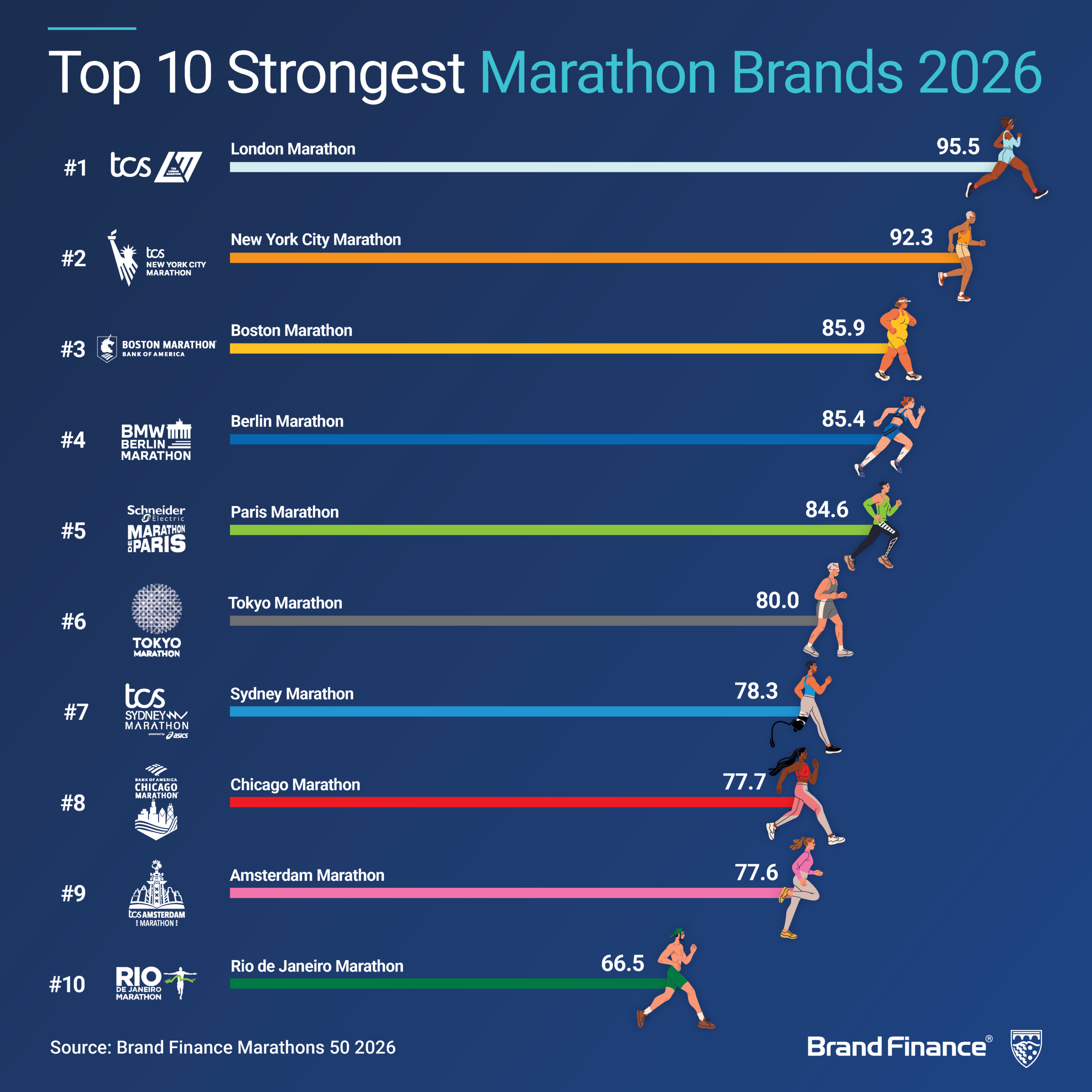
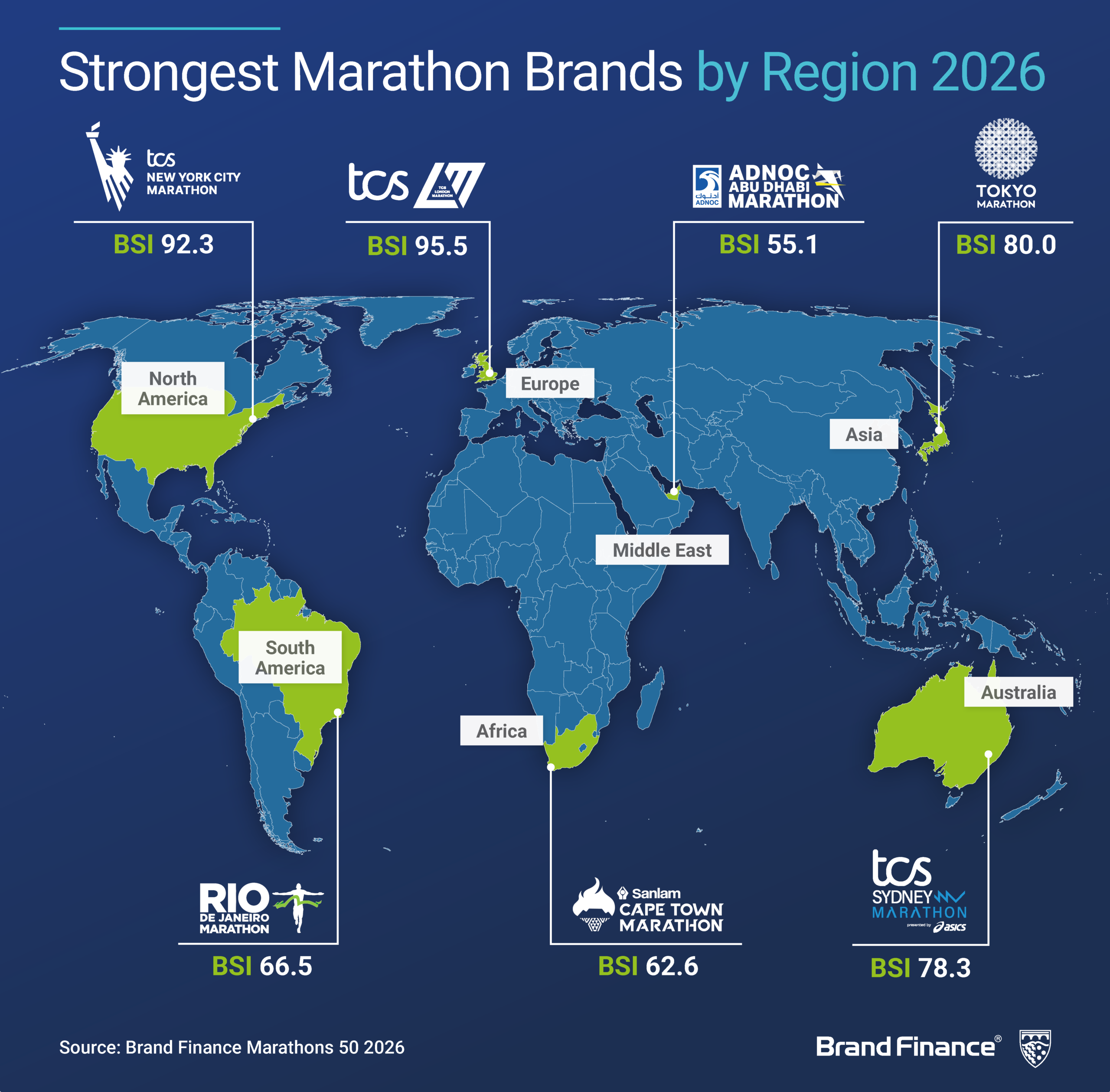
The London Marathon is the world's strongest marathon brand in 2026, with a Brand Strength Index (BSI) score of 95.5 out of 100. It leads New York City (92.3), Boston (85.9), Berlin (85.4) and Paris (84.6), which complete the global top five.
According to Brand Finance’s latest research, London records the strongest domestic perceptions of any marathon brand, with maximum scores for awareness and familiarity and top scores for runners’ willingness to take part and for being named their favourite marathon. London has continued to build on this strong reputation, with this year's 2026 TCS London Marathon setting a Guinness World Record with 59,830 finishers and raising more than GBP90 million for charity. It also received a record 1.33 million ballot entries for 2027, prompting organisers to stage a one-off two-day edition for 100,000 runners next year.
New York City is the world’s favourite marathon among international runners. It is also the only top 10 marathon whose international perceptions exceed its domestic score. International runners rank New York City highest for how well-known and widely recognised the race is, its reputation, their willingness to take part and its status as their favourite marathon. This weekend’s race, the 50th anniversary of the five-borough course, attracted more than 240,000 drawing applications from over 160 countries.
Beyond prestige, the race experience drives consideration
Brand Finance’s research finds that being seen as the best marathon in the world is the single largest driver of runners’ consideration to take part in a race, accounting for 32% of driving importance. But the wider experience matters too. Having a great atmosphere accounts for 11%, a great location for 8%, growing appeal for 7% and being well organised for 5%.
The Paris Marathon’s strength highlights that Major status is not a prerequisite for a leading marathon brand. Ranked fifth with a BSI score of 84.6, it is the highest-ranked race outside the Abbott World Marathon Majors. Runners at home and abroad rate it highly for its atmosphere, organisation and spectator experience. Tokyo (6th), Sydney (7th), Chicago (8th), Amsterdam (9th) and Rio de Janeiro (10th) complete the global top 10.
Several races outside the top 10 punch above their weight when it comes to international perceptions. Barcelona ranks 13th overall but 10th among international runners. Valencia and Cape Town rank 16th and 18th overall but 11th and 13th internationally. Cape Town’s international profile is set to grow further when it becomes the eighth Abbott World Marathon Major, and the first in Africa, in the 2027 season.
Scott Moore, Head of Sports Services, Brand Finance commented:
"The world's leading marathons have become powerful global brands, attracting runners from around the world and generating billions for their host cities. But our research shows that prestige alone is not enough. Atmosphere, organisation and the overall race experience all play a hugely important role in shaping where runners want to race.
"For marathon organisers, understanding what influences runners' perceptions and decisions is essential to building a stronger brand. Investing in the runner experience, strengthening international appeal and building meaningful connections with participants can help races attract greater demand, unlock commercial opportunities and create lasting value for their host cities. London and New York City demonstrate just how powerful that combination can be, but these lessons are relevant to marathon organisers at every level."
Beyond ranking the world's strongest marathon brands, the Brand Finance Marathons 50 report analyses the commercial, economic and societal impact of marathon running. It includes original Brand Finance research into runners' motivations, training habits and wellbeing, identifying six distinct runner personas and exploring how marathons inspire healthier, more active communities. The report also examines how technology and sponsorship are enhancing the runner experience, and how major races can strengthen their host cities' international reputation and soft power. Industry perspectives from Tata Consultancy Services, Marathon Tours & Travel, Mastercard, New York Road Runners and World Athletics also feature.
[1]Since Brand Finance conducted its research, the number of Abbott World Marathon Majors has increased to eight, following the confirmation of the Cape Town Marathon as the eighth Major in June 2026.


Brand Finance is the world’s leading brand valuation consultancy. Bridging the gap between marketing and finance, Brand Finance evaluates the strength of brands and quantifies their financial value to help organisations make strategic decisions.
Headquartered in London, Brand Finance operates in over 25 countries. Every year, Brand Finance conducts more than 6,000 brand valuations, supported by original market research, and publishes over 100 reports which rank brands across all sectors and countries.
Brand Finance also operates the Global Brand Equity Monitor, conducting original market research annually on 6,000 brands, surveying more than 175,000 respondents across 41 countries and 31 industry sectors. By combining perceptual data from the Global Brand Equity Monitor with data from its valuation database — the largest brand value database in the world — Brand Finance equips ambitious brand leaders with the data, analytics, and the strategic guidance they need to enhance brand and business value.
In addition to calculating brand value, Brand Finance also determines the relative strength of brands through a balanced scorecard of metrics, compliant with ISO 20671.
Brand Finance is a regulated accountancy firm and a committed leader in the standardisation of the brand valuation industry. Brand Finance was the first to be certified by independent auditors as compliant with both ISO 10668 and ISO 20671 and has received the official endorsement of the Marketing Accountability Standards Board (MASB) in the United States.
Brand is defined as a marketing-related intangible asset including, but not limited to, names, terms, signs, symbols, logos, and designs, intended to identify goods, services, or entities, creating distinctive images and associations in the minds of stakeholders, thereby generating economic benefits.
Brand strength is the efficacy of a brand’s performance on intangible measures relative to its competitors. Brand Finance evaluates brand strength in a process compliant with ISO 20671, looking at Marketing Investment, Stakeholder Equity, and the impact of those on Business Performance. The data used is derived from Brand Finance’s proprietary market research programme and from publicly available sources.
Each brand is assigned a Brand Strength Index (BSI) score out of 100, which feeds into the brand value calculation. Based on the score, each brand is assigned a corresponding Brand Rating up to AAA+ in a format similar to a credit rating.
Brand Finance calculates the values of brands in its rankings using the Royalty Relief approach – a brand valuation method compliant with the industry standards set in ISO 10668. It involves estimating the likely future revenues that are attributable to a brand by calculating a royalty rate that would be charged for its use, to arrive at a ‘brand value’ understood as a net economic benefit that a brand owner would achieve by licensing the brand in the open market.
The steps in this process are as follows:
1 Calculate brand strength using a balanced scorecard of metrics assessing Marketing Investment, Stakeholder Equity, and Business Performance. Brand strength is expressed as a Brand Strength Index (BSI) score on a scale of 0 to 100.
2 Determine royalty range for each industry, reflecting the importance of brand to purchasing decisions. In luxury, the maximum percentage is high, while in extractive industry, where goods are often commoditised, it is lower. This is done by reviewing comparable licensing agreements sourced from Brand Finance’s extensive database.
3 Calculate royalty rate. The BSI score is applied to the royalty range to arrive at a royalty rate. For example, if the royalty range in a sector is 0-5% and a brand has a BSI score of 80 out of 100, then an appropriate royalty rate for the use of this brand in the given sector will be 4%.
4 Determine brand-specific revenues by estimating a proportion of parent company revenues attributable to a brand.
5 Determine forecast revenues using a function of historic revenues, equity analyst forecasts, and economic growth rates.
6 Apply the royalty rate to the forecast revenues to derive brand revenues.
7 Discount post-tax brand revenues to a net present value which equals the brand value.
Brand Finance has produced this study with an independent and unbiased analysis. The values derived and opinions presented in this study are based on publicly available information and certain assumptions that Brand Finance used where such data was deficient or unclear. Brand Finance accepts no responsibility and will not be liable in the event that the publicly available information relied upon is subsequently found to be inaccurate. The opinions and financial analysis expressed in the study are not to be construed as providing investment or business advice. Brand Finance does not intend the study to be relied upon for any reason and excludes all liability to any body, government, or organisation.
The data presented in this study form part of Brand Finance's proprietary database, are provided for the benefit of the media, and are not to be used in part or in full for any commercial or technical purpose without written permission from Brand Finance.
