




This article was originally published in the Brand Finance Food & Drink 2026 report.
Brand Finance analysis reveals that more than a quarter of the combined brand value of the Food 100 2026 is exposed to structural shifts in consumption associated with GLP-1 adoption, with this exposure growing faster than the sector’s overall brand value. *

Valuation Director,
Brand Finance
The impact of weight-loss drugs will not be felt evenly across the food sector. For brand owners, the question is increasingly where GLP-1 exposure sits within their portfolios. By suppressing appetite, drugs such as Ozempic and Wegovy can shift spending away from high-calorie, discretionary foods towards protein, smaller portions and foods associated with satiety. This leaves companies concentrated in snacking and confectionery more exposed than those diversified across protein, functional nutrition and health-adjacent categories.
For the world's leading food companies, the question is no longer whether GLP-1s matter, but how exposed their portfolios are. Brand Finance assessed each of the world’s 100 most valuable food brands based on the share of brand revenues generated in categories exposed to GLP-1-driven shifts in consumption.
How we measured it
For each of the 100 brands in the Food 100, Brand Finance estimated the share of revenue generated in categories research identifies as most exposed to GLP-1-driven changes in consumption – including savoury snacks, confectionery, sweet bakery and other discretionary, calorie-dense foods – and the share generated in less exposed categories such as fresh protein, dairy and infant nutrition. Applying this exposure percentage to each brand’s 2026 brand value gives its estimated value at risk.
Three points are important when interpreting the analysis. First, value at risk measures exposure, not forecast loss - a 45% exposure means 45% of a brand’s revenues sit in categories most susceptible to GLP-1 driven changes in consumption, not that sales are expected to fall by 45%.
Second, the relative sensitivity of categories is evidence-based, reflecting the pattern observed in the Journal of Marketing Research household panel, while the individual exposure percentages are Brand Finance estimates of each brand’s portfolio composition.
Third, the underlying category and adoption evidence is US-based, while the ranking is global, so exposure has been adjusted downwards for brands with greater weighting towards markets such as India, Indonesia, China and the Gulf, where GLP-1 adoption is currently lower.
The caveats also run in both directions. Reformulation, portion-size innovation and brand strength not modelled, but could help brands recapture some exposed revenue, while discontinuation of GLP-1 use may also reverse some changes in consumption. Conversely, the analysis excludes the household spillover effect, whereby non-users living with GLP-1 users also reduce consumption, which could increase overall exposure.
Where the $73 billion risk sits
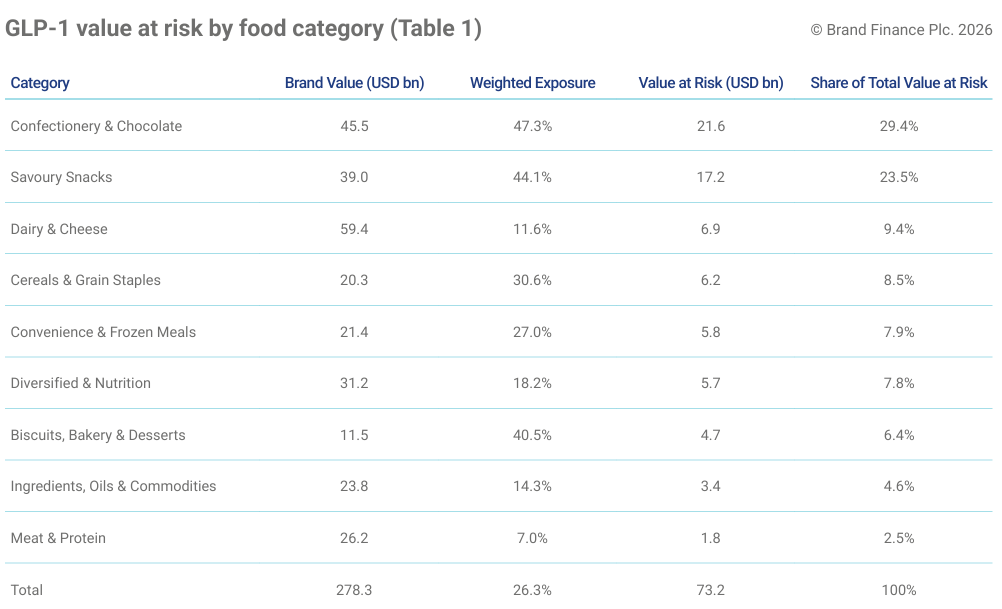
The analysis finds that USD73.2 billion of the Food 100's combined USD278.3 billion brand value sits in categories materially exposed to GLP-1-driven shifts in consumption, equivalent to 26.3% of the total ranking value.
That value at risk is heavily concentrated in a small number of categories (Table 1). Confectionery and chocolate and savoury snacks account for 53% of total value at risk, despite representing just 30% of the Food 100’s total brand value. Average exposure rates above 44% across these categories reflect their greater reliance on frequent, discretionary snacking occasions – among the consumption behaviours most affected by GLP-1 adoption.#
Snacking brands carry the greatest exposure
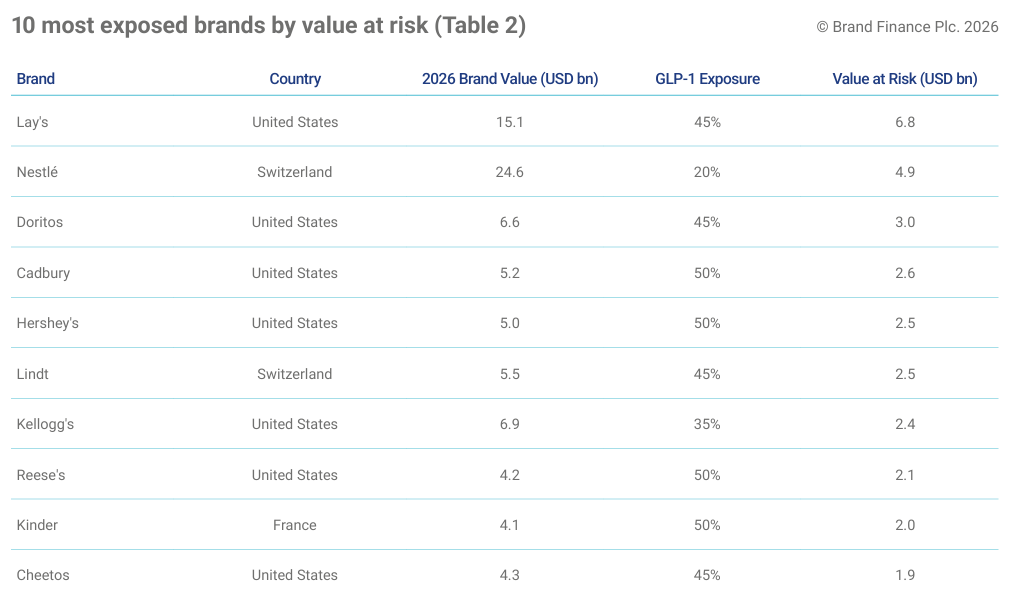
The same pattern becomes even clearer at the brand level (Table 2). Lay's alone carries USD6.8 billion of value at risk, accounting for just over 9% of the Food 100 total, while PepsiCo's five snack brands collectively account for USD14.1 billion. Across the ranking, 28 brands have exposure rates of 40% or higher, together representing USD90.7 billion in brand value – roughly one-third of the Food 100’s total value.
The exposed pool is not only large but growing faster than the sector around it. GLP-1 value at risk increased 15.7% year-on-year, outpacing like-for-like Food 100 brand value growth of 10.6%. This suggests that exposure to GLP-1-driven shifts in consumption is becoming more concentrated even as the sector itself grows.
Brand value growth is not yet reflecting GLP-1 exposure
Meat and protein brands sit at the other end of the exposure spectrum. With the lowest average exposure, at just 7%, the category appears comparatively well positioned for the protein-forward dietary shift associated with GLP-1 use. Yet its combined brand value fell 4.4% over the past year, suggesting that this potential structural advantage has yet to translate into stronger brand value performance.
That contrast is even more striking across the wider ranking. The 27 most exposed food brands with a 2025 comparative grew their combined brand value by 18% last year, compared with 7.4% for the 38 least exposed. In other words, brands most exposed to GLP-1-driven changes in consumption are currently growing faster than their lower-exposure peers, suggesting a disconnect between current brand value performance and longer term exposure to changing consumption patterns.
+15.7% vs +10.6%: GLP-1 value at risk grew faster than like-for-like Food 100 brand value, showing that exposure is increasing faster than the sector itself.
The portfolio problem
The figures point to a clear divide. GLP-1s do not threaten food brands uniformly; risk is greatest for portfolios concentrated in discretionary snacking and confectionery, with limited presence across protein, functional nutrition or health-adjacent segments.
For food manufacturers, the response therefore extends beyond reformulating individual products. The bigger strategic question is where brand value is concentrated across the portfolio, and whether companies can build stronger positions in categories better aligned with changing consumption habits.
Brand Finance’s analysis suggests that weighted average GLP-1 exposure can provide a useful lens for assessing this longer-term portfolio risk – one that brand owners, investors and lenders should increasingly consider as part of long-term brand valuation and portfolio planning.
The headline figure is USD73 billion of brand value at risk, but the deeper question is portfolio resilience. Food manufacturers that reassess their portfolios now have an opportunity to reduce dependence on highly exposed categories and create new avenues for growth as eating habits evolve. Those that do not risk protecting today’s strongest brands while leaving tomorrow’s portfolio increasingly exposed.
Buying the fix: Why portfolio response is increasingly inorganic
For many of the brands identified above, the fastest route to rebalancing exposure may be acquisition rather than innovation alone. Across the food and beverage industry, M&A activity is already shifting towards categories this analysis identifies as less exposed to GLP-1-driven changes in consumption – including protein, functional nutrition and better-for-you offerings – even as overall dealmaking has cooled.
The shift is visible in deal activity. GlobalData data shows health & wellness-themed acquisitions rising from around 15% of global consumer goods deal volume in early 2024 to nearly 23% by mid-year. By 2025, Carter Morse & Mattie, a Kroll business, put health & wellness deals at a record 25.9% of food and beverage M&A activity by volume, even as overall dealmaking declined. Across independent datasets, the direction is consistent: health & wellness is taking a growing share of sector M&A.
The brand-level evidence reinforces the category divide identified in this analysis. PepsiCo – carrying USD14.1 billion of value at risk across its snack portfolio – acquired prebiotic soda brand Poppi for USD1.95 billion and has taken an 11% stake in Celsius Holdings. Hershey, with 50% exposure across both Reese’s and its core confectionery brand, acquired clean-label popcorn maker LesserEvil as it expands further into better-for-you snacking.
Elsewhere, Danone acquired complete-nutrition brand Huel for approximately EUR1 billion, while Flowers Foods paid USD795 million for gluten-free brand Simple Mills. In each case, the acquirer sits on the higher-exposure side of this analysis, while the acquired brand provides greater exposure to categories aligned with evolving health and nutrition trends.
These deals suggest that portfolio rebalancing is already under way, with major food companies using acquisition to build positions in areas such as functional nutrition, protein and better-for-you products that are comparatively less exposed to GLP-1-driven changes in consumption.
This also sharpens the strategic question for highly exposed portfolio owners: as competition for attractive lower-exposure assets increases, the pool of acquisition targets may narrow and valuations may rise. The earlier companies assess and address concentration risk, the more options they are likely to have for rebalancing their portfolios.
*GLP-1 revenue exposure is a Brand Finance
estimate of the proportion of each brand’s revenue generated
from food categories identified as most exposed to shifts
in consumption associated with GLP-1 adoption. Category
sensitivity is informed by Hristakeva, Liaukonytė and Feler,
'The No-Hunger Games', Journal of Marketing Research (2026),
which found that U.S. households reduced grocery spending
by 5.3% within six months of starting a GLP-1. Savoury snack
spending declined 10.1%, while yogurt and fresh produce
were the only categories to rise. Adoption context is based
on Gallup's National Health and Well-Being Index (July 2026),
which estimates current GLP-1 usage among US adults at
11%. Value at risk is calculated by applying estimated revenue
exposure to 2026 brand value and represents brand value
operating in GLP-1 exposed categories, rather than a
forecast of future brand value loss.