





The findings were unveiled at an Asociación del Fútbol Argentino and Brand Finance event in New York highlighting the team’s global reach and commercial power
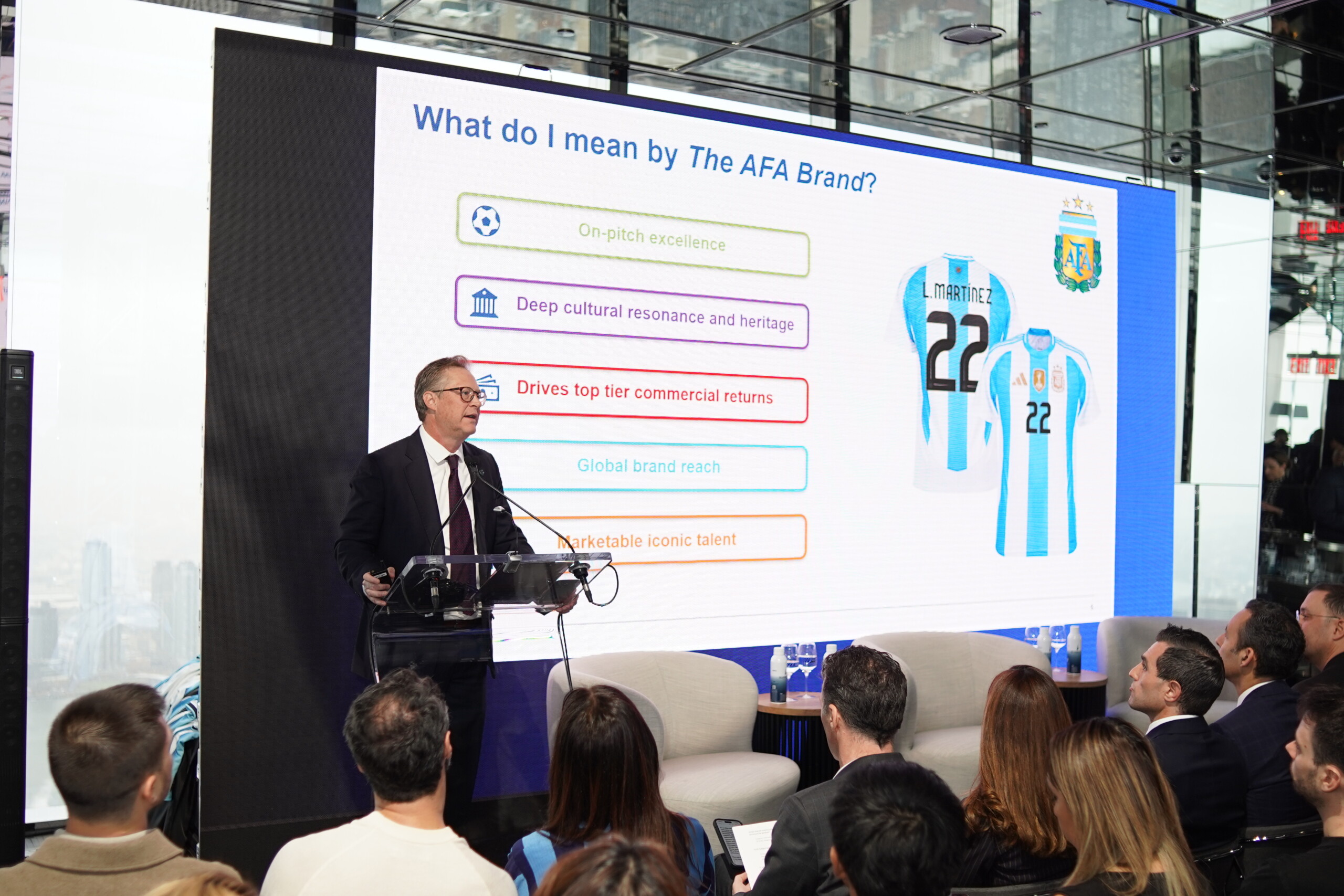
New York, December 3 – On December 2nd, the Asociación del Fútbol Argentino (AFA) and Brand Finance brought together senior leaders from across global sport for an event in New York exploring the continued rise of the AFA as one of the world’s most powerful sports brands. The event examined how the federation’s long-term brand strategy, on-pitch success and global fan engagement have helped transform Argentina’s national team into a commercial and cultural force with worldwide influence.
The day also featured contributions from representatives of the AFA, FIFA, the National Basketball Players Association (NBPA), and Brand Finance.
Brand Finance’s latest analysis shows the AFA is the strongest national football (soccer) brand in the world, with a Brand Strength Index score of 90.7 out of 100, placing it well ahead of major footballing nations including Brazil, Germany, France and England. The scale of this lead reflects more than sporting performance; the AFA now competes in the same brand-strength territory as some of the world’s most recognized consumer and corporate brands, from Nike and Coca-Cola to Dior, McDonald’s and YouTube. The federation has evolved from a sporting institution into a global brand with reach, cultural weight and commercial momentum comparable to the biggest names in international business.
Laurence Newell, Managing Director, Brand Finance Americas, commented:
“What stands out about the AFA is not simply that it leads the football world on brand strength, it is how comfortably it now sits in the company of the world’s most influential brands. Very few organizations, in or outside sport, command this level of emotional resonance and international recognition. The AFA has built a brand with the scale, clarity and cultural impact that global businesses spend decades striving to achieve.”
The AFA’s influence extends well beyond football. Across Brand Finance’s Global Soft Power Index, Argentina consistently benefits from the visibility and emotional pull of its national teams, with the federation acting as one of the country’s most effective ambassadors. International audiences respond strongly to the teams’ profile, with familiarity deepening, perceptions improving and positive engagement rising as the AFA’s global presence grows.
This effect is reinforced by Brand Finance’s nation brand research, which shows that football fans report significantly stronger perceptions of Argentina across both emotional and functional dimensions, including rich heritage, trustworthiness, ease of doing business and economic stability. They are also more likely to recommend visiting, studying in and trading with Argentina, demonstrating the meaningful impact that associations with the AFA have on the country’s global competitiveness.
Leandro Petersen, Chief Commercial & Marketing Officer at AFA, commented:
“Standing here today, showcasing the AFA in a market like the United States, shows how far the organization has come. The national team has become one of Argentina’s most powerful ambassadors, strengthening the country’s image everywhere we go.”
This strength also translates into substantial value for commercial partners. Brand Finance data also shows the commercial impact of AFA partnerships across multiple markets. American Express records higher awareness, familiarity and usage among football followers in key countries, while Indian dairy brand Amul has seen double-digit increases in familiarity, consideration and usage following major tournaments. These effects are reflected across Brand Finance’s wider global database, with AFA associations strengthening brand perceptions for partners in categories ranging from financial services and FMCG to apparel and technology.
Petersen added:
“More than 100 companies now partner with the AFA brand across all levels of Argentine football, something that would have been unthinkable a few years ago. Our strategy is simple: think globally and execute locally. Every market, from China to the United States, has its own plan, and that approach is what allows the AFA to keep growing its international footprint.”
The gathering in New York also provided a moment to look ahead, with discussions centered on how the AFA can build on its current position and continue strengthening its global profile. Speakers noted that becoming a global brand is only the starting point; maintaining that status requires sustained focus, continued investment and a clear long-term strategy to keep the AFA progressing on and off the pitch.
Petersen concluded:
“We do not see ourselves as just a football team; we manage a global sports and entertainment brand. The investments we are making in youth development, new training centers and international academies are long-term commitments that will remain long after any of us have gone. That is the legacy we want to leave for Argentine football.”
ENDS
Media Contacts
Florina Cormack-Loyd
Brand Finance Press Inquiries
+1 647-264-4102
f.cormackloyd@brandfinance.com
Melisa Zurita
AFA Press Inquiries
+1 (561) 504-0589.
About the Asociación del Fútbol Argentino (AFA)
The Asociación del Fútbol Argentino is the institution responsible for organizing and regulating national championships across Argentina on a global level. It oversees the operations and logistics for all members of the country’s various national football teams and also organizes Argentina’s AFA Futsal Championship and beach soccer tournaments.
Founded in 1893 under the name Argentine Association Football League, it is one of the oldest football associations on the continent. After several name changes, the adoption of Spanish-language terms, splits, and mergers, it took on the name Asociación del Football Argentino in 1934 and later, in 1946, its definitive name, the Asociación del Fútbol Argentino. It has been affiliated with FIFA since 1912 and with CONMEBOL - of which it is a founding member - since 1916.








Brand Finance is the world’s leading brand valuation consultancy. Bridging the gap between marketing and finance, Brand Finance evaluates the strength of brands and quantifies their financial value to help organisations make strategic decisions.
Headquartered in London, Brand Finance operates in over 25 countries. Every year, Brand Finance conducts more than 6,000 brand valuations, supported by original market research, and publishes over 100 reports which rank brands across all sectors and countries.
Brand Finance also operates the Global Brand Equity Monitor, conducting original market research annually on 6,000 brands, surveying more than 175,000 respondents across 41 countries and 31 industry sectors. By combining perceptual data from the Global Brand Equity Monitor with data from its valuation database — the largest brand value database in the world — Brand Finance equips ambitious brand leaders with the data, analytics, and the strategic guidance they need to enhance brand and business value.
In addition to calculating brand value, Brand Finance also determines the relative strength of brands through a balanced scorecard of metrics, compliant with ISO 20671.
Brand Finance is a regulated accountancy firm and a committed leader in the standardisation of the brand valuation industry. Brand Finance was the first to be certified by independent auditors as compliant with both ISO 10668 and ISO 20671 and has received the official endorsement of the Marketing Accountability Standards Board (MASB) in the United States.
Brand is defined as a marketing-related intangible asset including, but not limited to, names, terms, signs, symbols, logos, and designs, intended to identify goods, services, or entities, creating distinctive images and associations in the minds of stakeholders, thereby generating economic benefits.
Brand strength is the efficacy of a brand’s performance on intangible measures relative to its competitors. Brand Finance evaluates brand strength in a process compliant with ISO 20671, looking at Marketing Investment, Stakeholder Equity, and the impact of those on Business Performance. The data used is derived from Brand Finance’s proprietary market research programme and from publicly available sources.
Each brand is assigned a Brand Strength Index (BSI) score out of 100, which feeds into the brand value calculation. Based on the score, each brand is assigned a corresponding Brand Rating up to AAA+ in a format similar to a credit rating.
Brand Finance calculates the values of brands in its rankings using the Royalty Relief approach – a brand valuation method compliant with the industry standards set in ISO 10668. It involves estimating the likely future revenues that are attributable to a brand by calculating a royalty rate that would be charged for its use, to arrive at a ‘brand value’ understood as a net economic benefit that a brand owner would achieve by licensing the brand in the open market.
The steps in this process are as follows:
1 Calculate brand strength using a balanced scorecard of metrics assessing Marketing Investment, Stakeholder Equity, and Business Performance. Brand strength is expressed as a Brand Strength Index (BSI) score on a scale of 0 to 100.
2 Determine royalty range for each industry, reflecting the importance of brand to purchasing decisions. In luxury, the maximum percentage is high, while in extractive industry, where goods are often commoditised, it is lower. This is done by reviewing comparable licensing agreements sourced from Brand Finance’s extensive database.
3 Calculate royalty rate. The BSI score is applied to the royalty range to arrive at a royalty rate. For example, if the royalty range in a sector is 0-5% and a brand has a BSI score of 80 out of 100, then an appropriate royalty rate for the use of this brand in the given sector will be 4%.
4 Determine brand-specific revenues by estimating a proportion of parent company revenues attributable to a brand.
5 Determine forecast revenues using a function of historic revenues, equity analyst forecasts, and economic growth rates.
6 Apply the royalty rate to the forecast revenues to derive brand revenues.
7 Discount post-tax brand revenues to a net present value which equals the brand value.
Brand Finance has produced this study with an independent and unbiased analysis. The values derived and opinions presented in this study are based on publicly available information and certain assumptions that Brand Finance used where such data was deficient or unclear. Brand Finance accepts no responsibility and will not be liable in the event that the publicly available information relied upon is subsequently found to be inaccurate. The opinions and financial analysis expressed in the study are not to be construed as providing investment or business advice. Brand Finance does not intend the study to be relied upon for any reason and excludes all liability to any body, government, or organisation.
The data presented in this study form part of Brand Finance's proprietary database, are provided for the benefit of the media, and are not to be used in part or in full for any commercial or technical purpose without written permission from Brand Finance.