




This article was originally published in the Brand Finance Airlines 50 2026.
When geopolitical disruption strikes, the distribution of impact across the aviation industry is never uniform. The events of early 2026 revealed a structural divergence between carriers insulated by network design, financial discipline, and brand strength, and those whose entire commercial model is predicated on the infrastructure now under threat.
Geopolitical exposure is displacing conventional financial metrics as the defining variable in airline resilience analysis. Brand Finance's assessment of the Airlines 50 2026 universe reveals a stark bifurcation: carriers with diversified networks, disciplined hedging, and high brand equity are structurally insulated, while those architecturally dependent on Gulf hub connectivity face a challenge of a fundamentally different character.
Gulf carriers - Most exposed
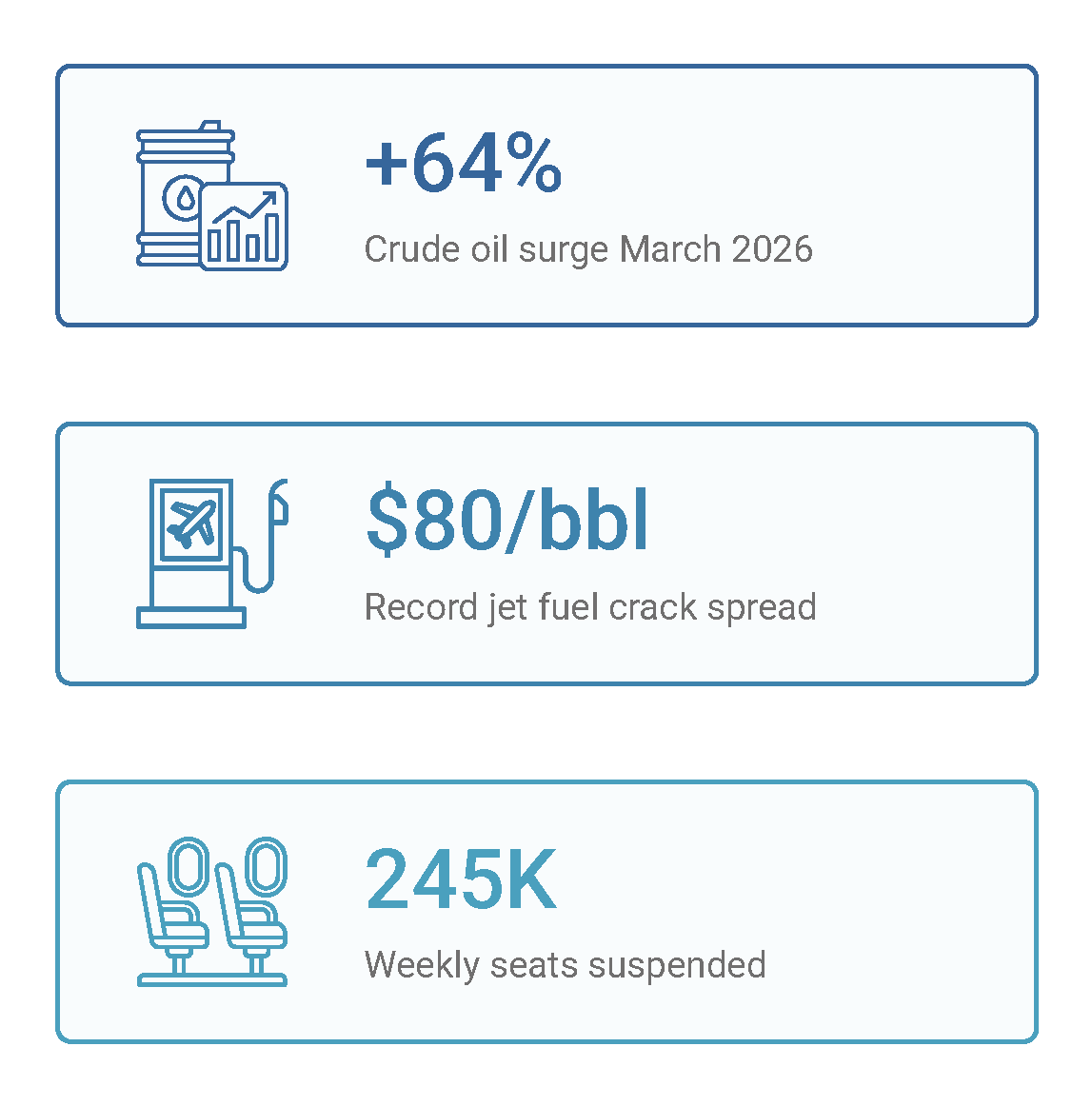
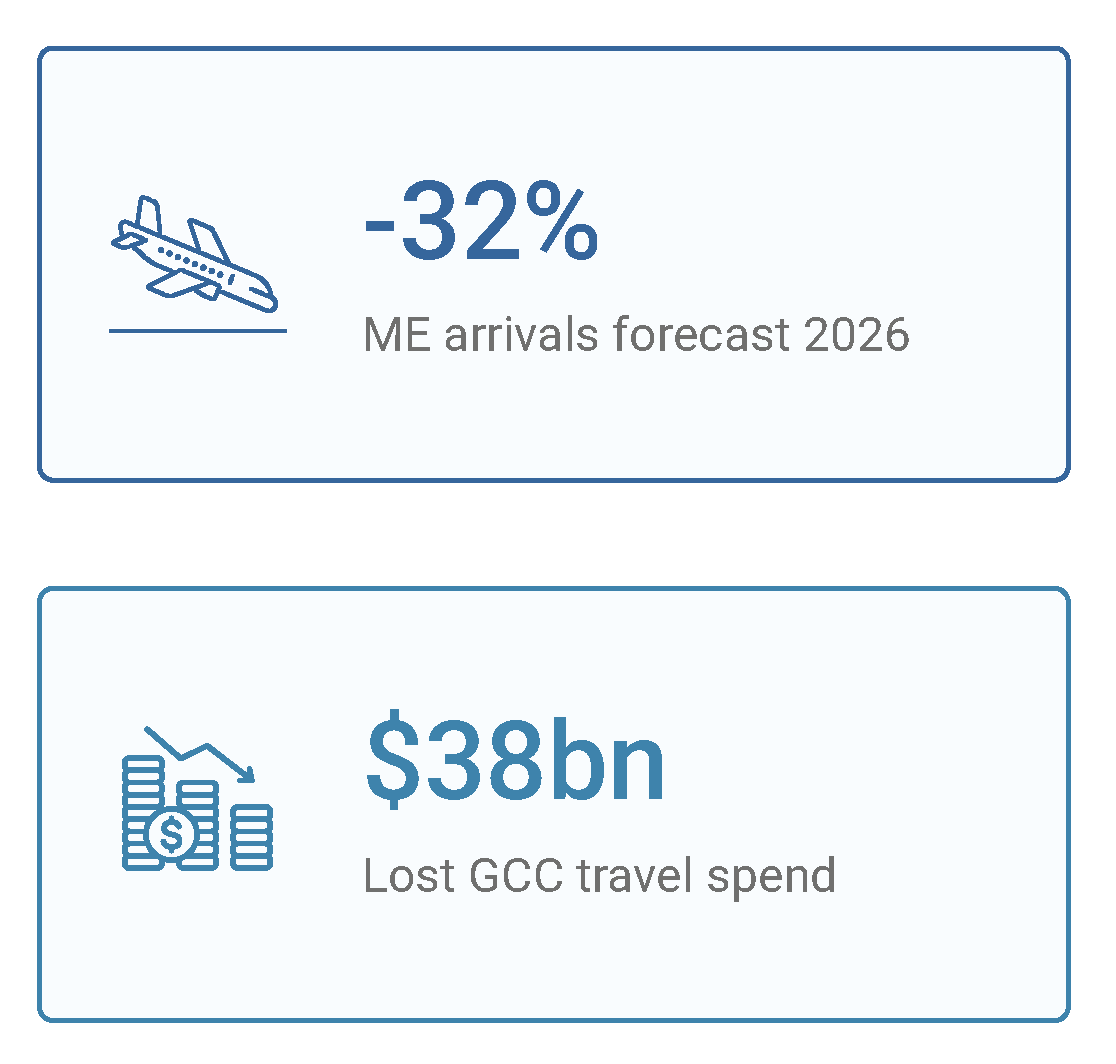
Gulf hub carriers represent the most acutely exposed business model in the current environment, not by virtue of managerial deficiency, but as a direct consequence of structural design. Their networks are engineered almost exclusively around connecting passengers through major Gulf transit hubs, linking Europe, Asia, Africa, and North America through a hub-and-spoke system that requires unimpeded Gulf airspace to function. When that airspace is compromised, the commercial implications are structural rather than marginal. There are no meaningful alternative routeing options available; unlike airlines anchored in large domestic markets, Gulf carriers have no capacity buffer to absorb sustained disruption. OAG scheduling data for the week of 23 March 2026 confirmed capacity reductions of 40 to 62 percent across the three principal Gulf carriers. Sovereign ownership provides critical insulation against insolvency risk. The financial backing of Gulf state governments substantially reduces the probability of existential failure. However, state ownership is not a revenue substitute: it preserves the institution whilst the disruption persists; it does not prevent the revenue destruction the disruption itself causes. The brand dimension introduces a critical variable. Strong BSI scores among the Gulf three suggest premium demand, corporate accounts and business class loyalty, will return strongly once operational normalcy resumes. The strategic question is whether connecting passengers will revert to Gulf hub routeings, or whether European and Asian alternatives will have captured durable market share during the period of enforced closure.
South Asian carriers - High exposure, limited mitigation
South Asian low-cost carriers present a qualitatively distinct and, in several respects, more acute risk profile. These carriers are disproportionately exposed to the India-Gulf labour migration and VFR corridor, one of the world's highest-volume bilateral traffic flows, characterised by high price sensitivity and structural dependence on Gulf employment demand. Disruption creates a revenue gap that domestic South Asian demand cannot fill. Fuel hedge coverage is typically modest, leverage elevated, and the sovereign backstops available to Gulf or state-owned Asian carriers are largely absent. The combination of structural revenue exposure, constrained financial headroom, and limited brand equity as a demand retention mechanism positions these carriers among the most financially vulnerable in the global ranking.
Oxford Economics Research Briefing (April 2026), commented:
Around one-fifth of Europe- Asia passenger demand and 10% of North America-Asia demand previously transited Gulf hubs. These are not peripheral traffic streams: they are the commercial foundation of the hub model. The best-hedged carrier in the aviation sector entered 2026 with 84% of its fuel requirement secured at $77 per barrel, a structural advantage unavailable to any unhedged competitor now facing oil prices above $110.
European network carriers - Moderate exposure, manageable
European full-service network carriers occupy a position of moderate and, crucially, manageable exposure. Their long-haul Asia services are disrupted by airspace restrictions, and rerouting via polar or Central Asian corridors adds fuel consumption and extends block times. These are real and quantifiable cost increases, but they do not represent a structural threat to the business model in the manner that Gulf exposure does. The critical differentiator is hedging discipline. Multiple major European airline groups entered 2026 with the majority of their anticipated fuel requirements locked in at pre-conflict prices. Network diversification further reinforces structural resilience: those with strong transatlantic franchises and established domestic markets can absorb long-haul demand compression without systemic revenue impairment.
European low-cost carriers - Net beneficiaries
Europe's short-haul low-cost sector is among the clearest structural beneficiaries of the current disruption. Carriers operating exclusively within the intra-European and North African short-haul market face zero direct exposure to Middle East airspace restrictions, and the demand substitution effect is commercially meaningful: travellers are redirecting spending toward Southern Mediterranean Europe. The best-hedged carrier in the aviation sector entered 2026 with 84% of its anticipated fuel requirement secured at $77 per barrel, a structural financial advantage unavailable to any unhedged competitor facing oil prices above $110. The combination of maximum hedge coverage, zero ME exposure, and growing inbound substitution demand positions the strongest European LCCs as one of the best risk-adjusted stories in global aviation for 2026.
North and Latin American carriers - Largely insulated
North and Latin American carriers are structurally insulated from the direct operational consequences of the conflict. Airspace restrictions in the Middle East have minimal bearing on networks oriented toward the Americas, the North Atlantic, or the trans-Pacific. The primary risk transmission mechanism is fuel cost: several US carriers have significantly reduced fuel hedging in recent years, leaving their cost structures exposed to spot market oil price movements. The broader demand environment provides a substantive counterweight. Domestic US travel demand has demonstrated sustained resilience throughout the conflict period. The 2026 FIFA World Cup, hosted across the United States, Canada, and Mexico, represents a material structural demand tailwind independent of geopolitical conditions. The highest brand values in the Airlines 50 are concentrated in this region, led by Delta at $18.6 billion and growing 24.8% year-on-year entering the crisis from a position of structural strength.
Asia-Pacific carriers - Mixed exposure, varies by carrier
The Asia-Pacific carrier universe presents the most heterogeneous risk picture in global aviation. Exposure varies significantly according to hub location, routing dependency on Gulf airspace, and the extent of domestic market insulation, producing outcomes ranging from material vulnerability to near-complete insulation within the same regional cohort. Carriers reliant on Gulf hub connectivity, particularly those operating Australia-Europe Kangaroo Route services or Southeast Asian long-haul European services, face meaningful rerouting costs. For these airlines, incremental fuel burn and block time associated with polar or Indian Ocean routing alternatives is a recurring cost that will persist for the duration of the restrictions. North Asian carriers are substantially better positioned. Japanese, Korean, and Chinese airlines with established polar routing alternatives and access to deep domestic markets can manage the conflict's disruption with limited structural adaptation. Chinese domestic carriers are additionally buffered by state ownership, government-administered fuel cost mechanisms, and the insulation of the world's largest domestic aviation market. Short-haul intra-Asian demand provides a further structural cushion. The overwhelming majority of inbound Asia-Pacific passenger growth in 2026 is expected to originate from within the region, demand largely independent of Gulf hub connectivity and therefore largely unaffected by the current disruption.
Brand equity as a resilience variable - The Brand Finance Dimension
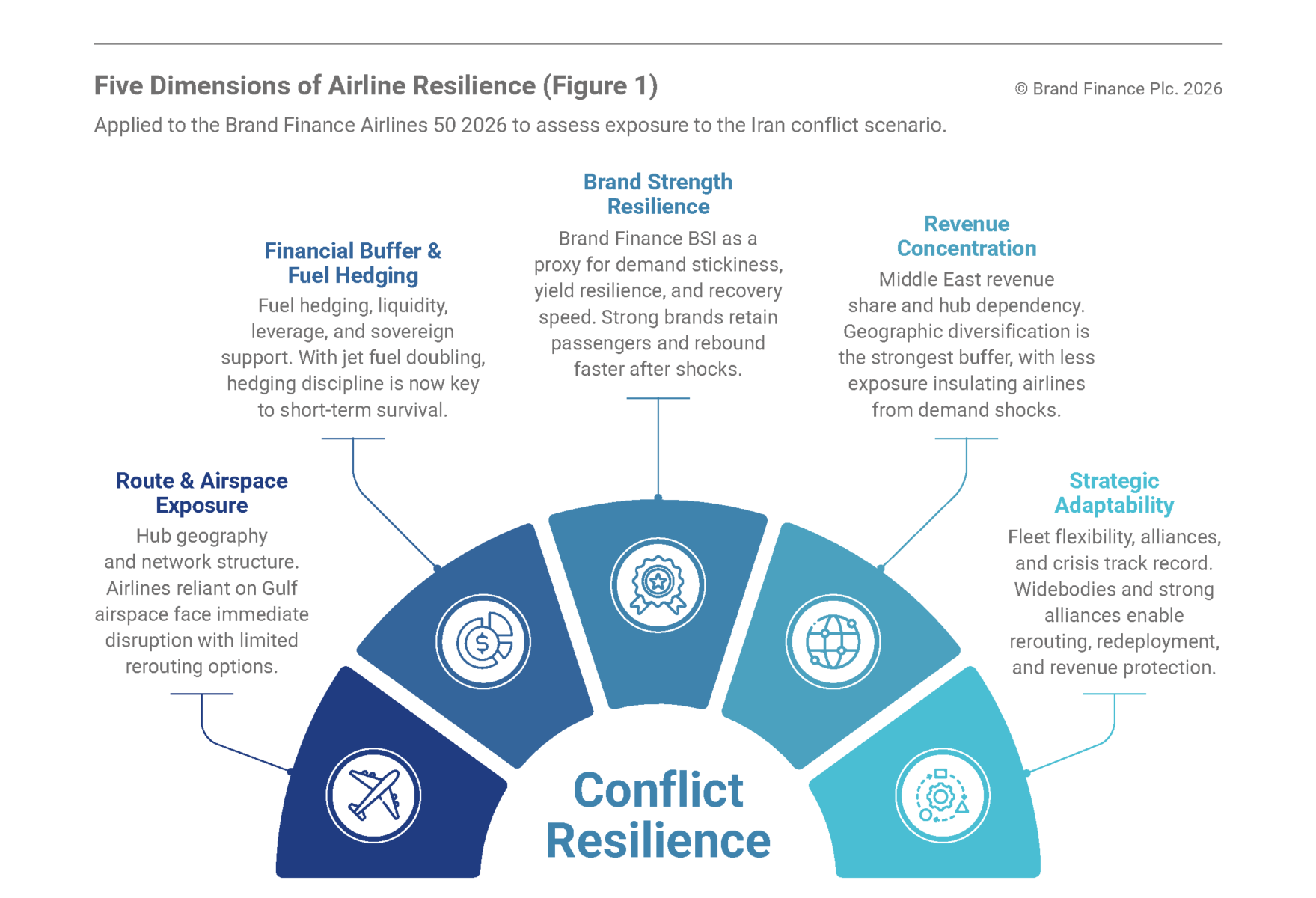
The role of brand strength in determining airline resilience under geopolitical stress is analytically distinct from its conventional commercial function. Under conditions of acute disruption, brand equity performs a different and operationally more critical role: it determines the rate at which demand recovers once the disruption abates. Airlines with high Brand Strength Index scores retain passenger intent through periods of operational constraint. Frequent flyers with strong brand preference rebook with the same airline when routes are temporarily suspended, rather than permanently switching to alternatives. Premium cabin loyalty is sustained at higher rates among high-BSI carriers, protecting revenue per available seat kilometre even when absolute load factors compress. The inverse relationship is equally consequential. Airlines with weakening brand equity entering a geopolitical shock face compounding risk: declining BSI scores signal eroding customer preference, and under the additional pressure of route disruption and higher fares, this accelerates the permanent switching behaviour that impairs post-crisis revenue recovery. In the 2026 airline universe, the carriers most acutely exposed to this dynamic are those combining structural Middle East dependency with declining brand trajectories, a configuration that the Airlines 50 data makes identifiable with considerable precision.
Recovery outlook
The Oxford Economics base case assumes a two-month conflict duration, with the majority of regional flight activity resuming by H2 2026 and a substantive demand recovery by 2027-28. Under this scenario, the disruption represents a severe but ultimately temporary revenue contraction for most of the airline industry. The structural lesson the 2026 disruption reinforces is one the industry has repeatedly identified but inconsistently applied: the carriers best positioned to withstand external shocks are those that enter them with diversified revenue bases, robust financial buffers, and strong brand equity that functions as a demand anchor when operational conditions deteriorate. In an environment where geopolitical shocks can alter demand patterns with little forewarning, a disciplined understanding of brand strength may prove as commercially consequential as balance sheet management. Declining brand equity entering a geopolitical shock compounds the structural revenue risk. Airlines that lose customer preference before a crisis are measurably slower to recover demand once it ends.