




This article was originally published in the Brand Finance Automotive Industry 2026.

The Autos sector has undergone significant shifts with respect to sustainability, mainly thanks to the introduction and scaling of EV options. Both legacy automakers and new challenger brands have met the moment in developing EVs for consumer uptake. However, global demand for new EVs is now slowing. Variable governmental support is a prime contributor, which can be seen through gaps in charging infrastructure and reduced purchase incentives. Waning support for these mechanisms helps maintain the cost differential between EVs and traditional vehicle models. Charging infrastructure is essential for consumer confidence in an EV’s driving range, and purchase incentives like subsidies or tax write-offs lower price barriers.
Consumer attitudes towards auto brands are therefore important to measure. Brand Finance’s Sustainability Perceptions Index assesses which brands are perceived to have the strongest commitment to sustainability and the changing role of sustainability in driving demand. In Autos, sustainability continues to be a powerful influence, driving 10.3% of consumer consideration in 2026. The luxury segment sees a pronounced difference in sustainability’s explanatory power, at 22.1%, more than two times higher than general Auto. The Index also calculates the large amounts of sustainability-based brand value at risk and being secured by global brands. Sustainability perceptions and performance often don’t align.

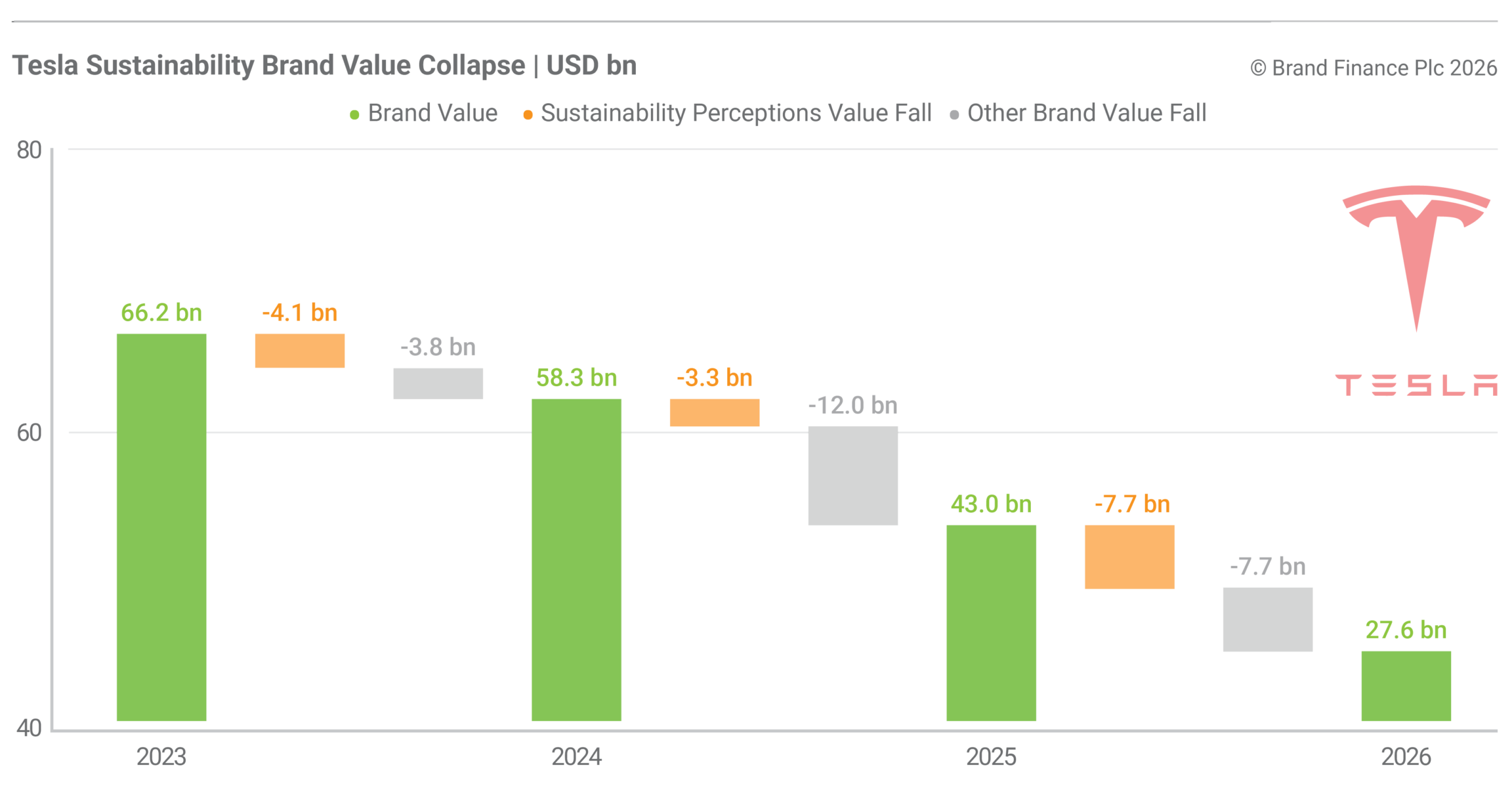
Where perception exceeds performance, value is at imminent risk, as brands leave themselves open to public backlash, reputational damage, and a downward ‘correction’ of their sustainability perceptions value. Tesla is a good example not just of where risk exists, but where real value continues to follow a downward trajectory forecasted by identified risk (Figure 1). The damage to Tesla’s brand value exceeded Brand Finance’s initial predictions. In 2023, its brand value stood at USD66 billion, USD17.8 billion of which was underpinned by sustainability. By early 2026, this has fallen to USD27.6 billion, with sustainability value down to USD2.7 billion. These latest numbers mark a 35.8% decline in brand value and 74.0% decline in Sustainability Perceptions Value since 2025. Tesla is well known for being a first mover in the development of electric vehicles and battery technology, often seen as the catalyst for the wider industry transition to EV portfolio offerings. In 2023 and 2024, we recorded Tesla’s positive sustainability perceptions held by global consumers. Tesla was regarded as the autos brand with the strongest commitment to sustainability in several markets researched by Brand Finance.
Tesla has undoubtedly driven progress in EV adoption, which contributes to society’s broader advancement of sustainability. However, Tesla’s sustainability performance scores are lower than the Autos sector average, due to issues with governance, labour relations, supply chain oversight, and the environmental performance of its own operations. More unique to Tesla compared to other automakers is its leadership. Tesla CEO Elon Musk has always been seen as an eccentric visionary, with fiercely held political views. Musk’s recent stint serving in the Trump administration to promote government efficiency through layoffs drew extreme controversy. Continued governance lapses at his second company, X, over misuse taking place on its AI platform only further alienated Tesla’s supporters.
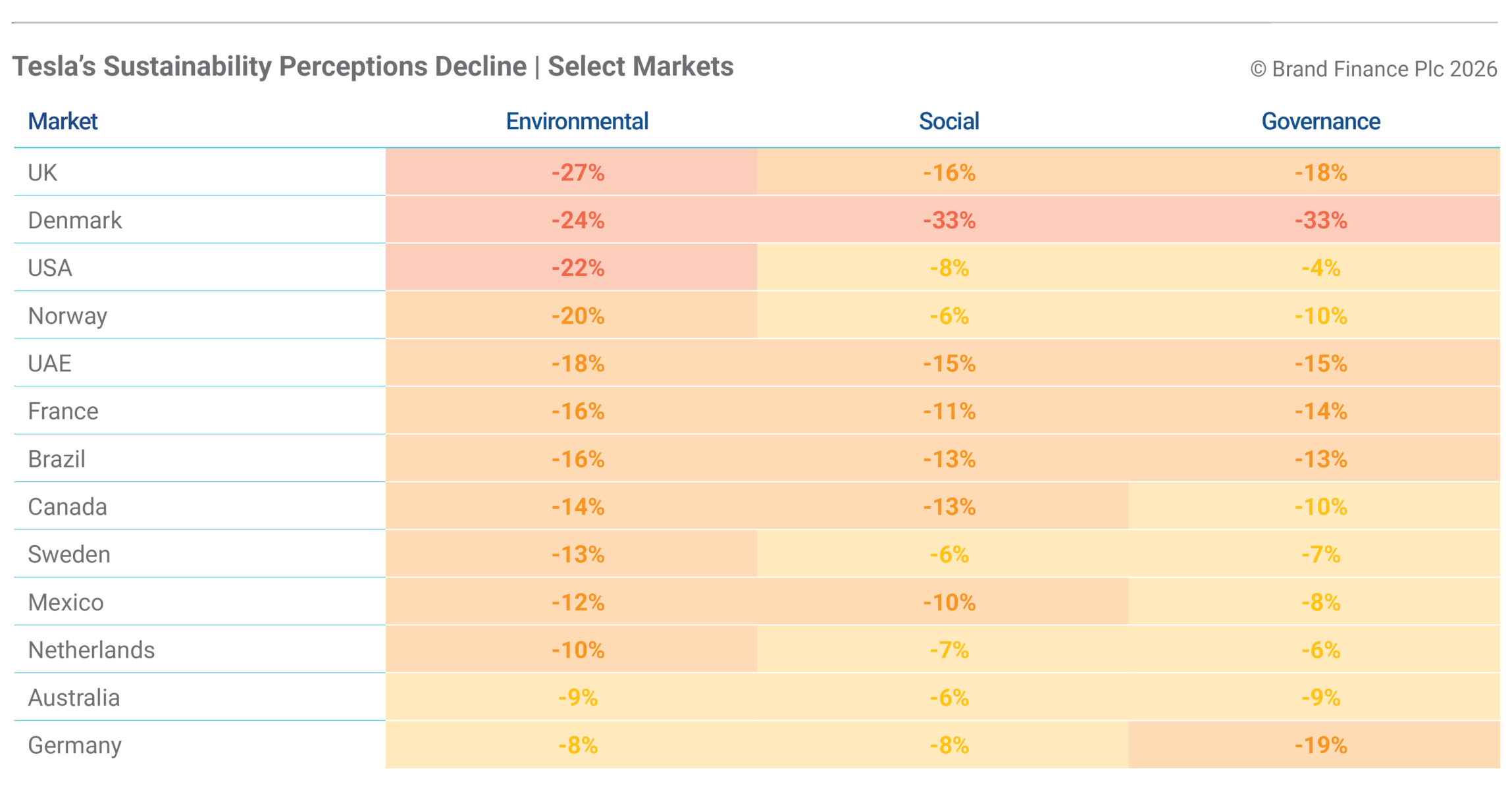
From 2024 to 2026, Tesla’s perceived environmental sustainability commitment fell in almost all of the markets Brand Finance researches. In this 3-year period, double digit percentage drops for sustainability perceptions have occurred in most of Tesla’s research markets (Figure 2). The largest declines occur in Western, higher-income markets like the UK, Denmark, US, Norway, France, Canada, Netherlands, and Germany. At this point, we observe perceptions declining beyond just the environmental dimension, where EV enthusiasm more broadly has waned. Social and governance scores for Tesla fell as much as and sometimes more than environmental perceptions. In essence, EV leadership and associated sustainability benefits no longer protect the Tesla brand, despite today’s awareness of climate change and maturity of the EV market being higher than ever. Tesla isn’t the only EV maker suffering. BYD is widely viewed as the second disruptor to EV innovation, coming in strong after Tesla had already prompted the mainstream automakers to introduce hybrid and/or EV offerings.
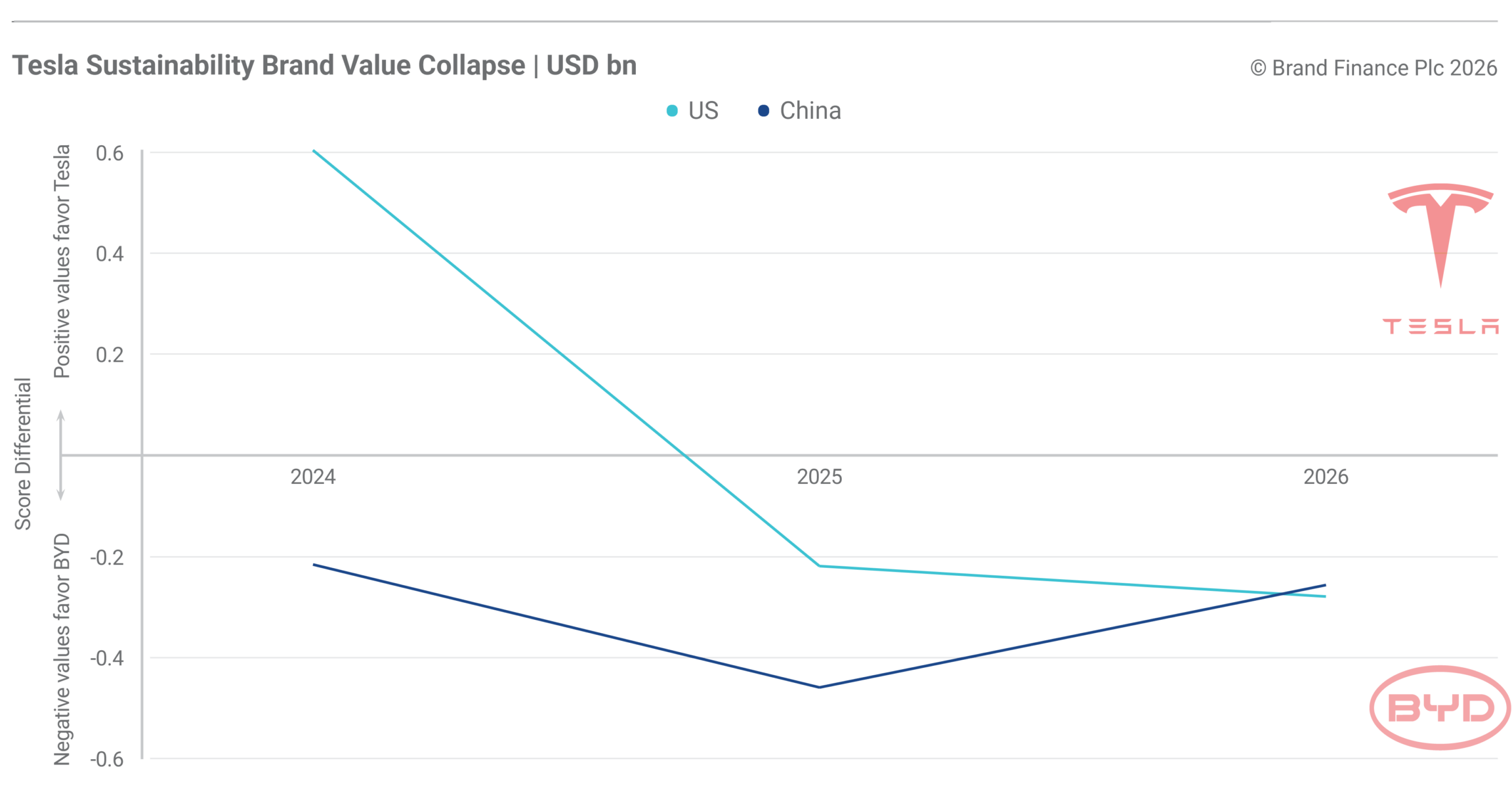
However, BYD came in with lower prices, delivering accessibility to the EV market at scale at a time when price considerations were already a major barrier. As a result, BYD powered ahead and stifled sales from many European automakers. Brand Finance has researched both BYD and Tesla in the US and China for three years. In this time, we have captured the shifts in public sentiment regarding both brands’ sustainability perceptions (Figure 3). While Tesla initially held higher environmental sustainability perceptions than BYD in the US, BYD now leads in 2026. In China, both brands have seen a decline in their sustainability perceptions. For BYD, the decline in perceptions may be tied to environmental and social impacts from the brand’s growth. These perceptions shifts may indicate a change in public understanding of Autos sustainability. Even for pure-play EV makers, decent sustainability perceptions are no longer a given. Consumer scrutiny of brand sustainability is ever-growing, especially in Europe where we find net agreement with corporate commitments lower than the rest of the world.
Tesla is a case in point for value erosion when there is a persistent or worsening mismatch between sustainability perceptions and performance. Relying on a reputation as a more sustainable option in the market is no longer an option - performance slips have proven to undercut the communications and associations held by consumers. Brands in the Autos sector must work to close their perception-performance gaps comprehensively across environment, social, and governance.