




This article was originally published in the Brand Finance Aerospace & Defence 25 2026.

In 2026, the aerospace industry is witnessing a shift between its two largest players, Airbus and Boeing, as their trajectories diverge across delivery performance, backlog strength, stakeholder perception, and geopolitical factors. The shift in leadership is notable due to Boeing’s six-year run at the top. While Boeing continues to grow in brand value, it lags the sector average, reflecting a gradual recovery. In contrast, Airbus is outpacing the industry, with stronger execution and shifting perceptions reinforcing its lead.
Airbus (brand value up 63% to USD27.2 billion) has ascended to the top of the rankings, a rise fuelled by strong commercial execution, and robust demand for its next generation aircraft. In 2025, Airbus delivered 793 commercial aircraft, outpacing competitors and reinforcing its revenue outlook as airlines continued fleet renewals and capacity expansions. Its order backlog reached a historic high of 8,754 aircraft, one of the largest in industry history. The A320neo family remains central to Airbus’ growth, with the A321XLR attracting interest due to its extended range and efficiency. Surpassing the Boeing 737 as the most delivered jetliner has strengthened the brand’s credibility, causing its BSI score to increase from 82/100 in 2025 to 91.5/100 in 2026, reflecting broad gains in familiarity, credibility, and appeal.
Airbus’ growth also extends beyond commercial aviation. A diversified defence portfolio, which includes programmes such as the Eurofighter Typhoon and expanded helicopter operations, reinforces its multidomain presence. International partnerships in defence and space, alongside early initiatives in ZEROe hydrogen concepts and SAF adoption, have further strengthened the brand’s positioning. Boeing (brand value up 34% to USD24.4 billion) remains a major player but has ceded leadership amid challenging market conditions. In 2025, it delivered around 600 commercial aircraft, trailing behind Airbus, while production and certification delays on the 777X and 787 Dreamliner constrained deliveries and triggered a near USD 5 billion charge. Despite securing over 1,000 gross orders, Boeing’s delivery performance and backlog lags behind Airbus. Its defence portfolio continues to support revenue and brand relevance, with ongoing programmes in military aircraft, rotorcraft, and space providing diversification amid commercial market fluctuations.
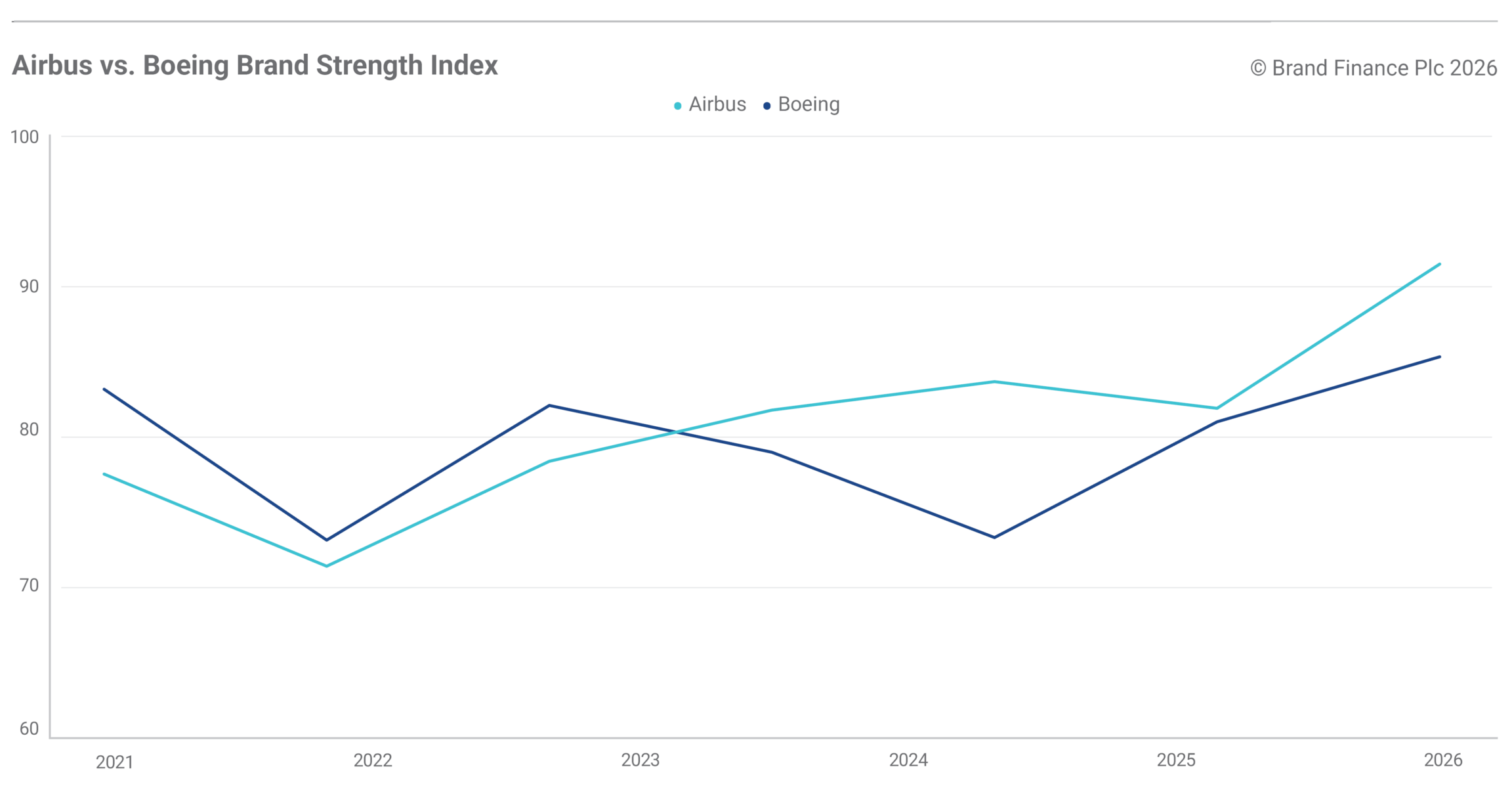
Boeing’s BSI rose moderately to 85.3/100 in 2026 (from 81/100 in 2025), reflecting a gradual rebuilding of confidence. Technical credibility, operational heritage, and long-standing customer relationships remain strong, though geopolitical tensions, particularly in the Middle East, have slightly softened global perceptions of US industrial brands, impacting Boeing’s international momentum. The contrast between Airbus and Boeing reflects a broader industry shift. Airbus’s strong deliveries, record backlog, and expanding defence and sustainability portfolios have propelled it ahead in both brand value and perception, while Boeing’s efforts to rebuild trust and stabilise production highlight the challenges of restoring leadership after disruptions. This divergence illustrates how, in a growing global aerospace market, future leadership will hinge less on heritage alone and more on operational resilience, reliable delivery, and sustained stakeholder confidence.