




This article was originally published in the Brand Finance Automotive Industry 2026.

As the global transition to electric vehicles accelerates, Chinese automotive brands are rapidly expanding their global footprint, demonstrating robust growth across multiple key markets, including Europe, Asia, Middle East and Latin America. Among these, Europe is emerging as a significant strategic battleground. While Chinese brands may still be relatively new to European consumers, they are already outperforming established local competitors on key drivers of purchase decisions, including technology, innovation, sustainability and value for money. The awareness gap is real, and it just reflects recency; the fact that for respondents familiar with these brands they are already overtaking some legacy and strong brands in Europe is an early indicator of the progress that it might come.
A natural gap for brands that are new to market
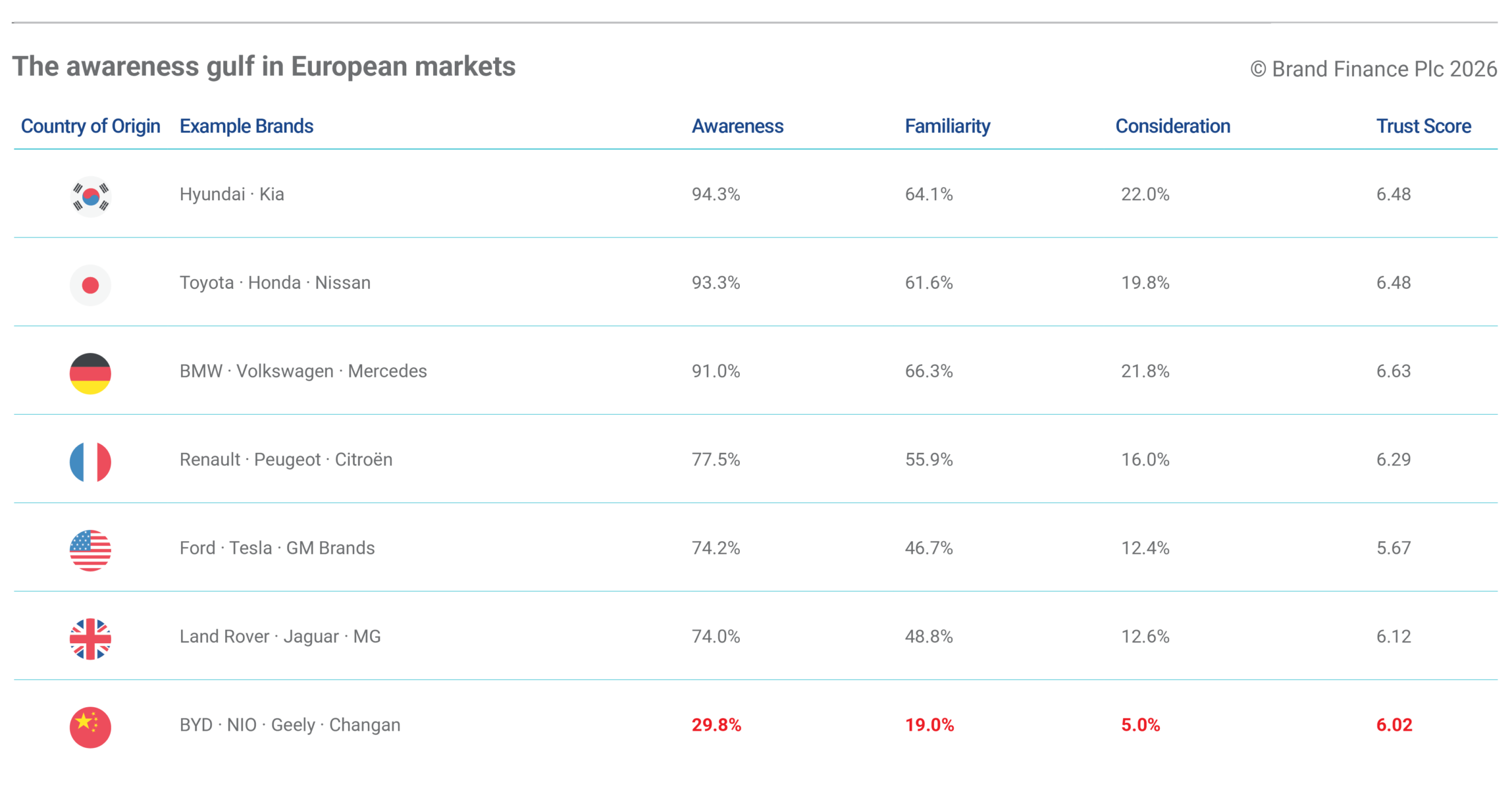
Across the European markets analysed, namely France, Germany and the United Kingdom, Chinese automotive brands achieve an average awareness level of 30%, compared with more than 90% for German, Japanese and Korean brands. Familiarity stands at 19%, while consideration is at 5%, well below the roughly 60% familiarity and over 20% consideration typically seen among established competitors.
These figures are not surprising. German, Japanese and Korean brands have spent decades building their presence in Europe through dealership networks, sponsorships, advertising and, most importantly, time. Chinese brands, by contrast, are still relatively new to these markets. The awareness gap reflects a shorter track record, but the gap is closing fast.
Leading on the metrics that define the modern car buyer
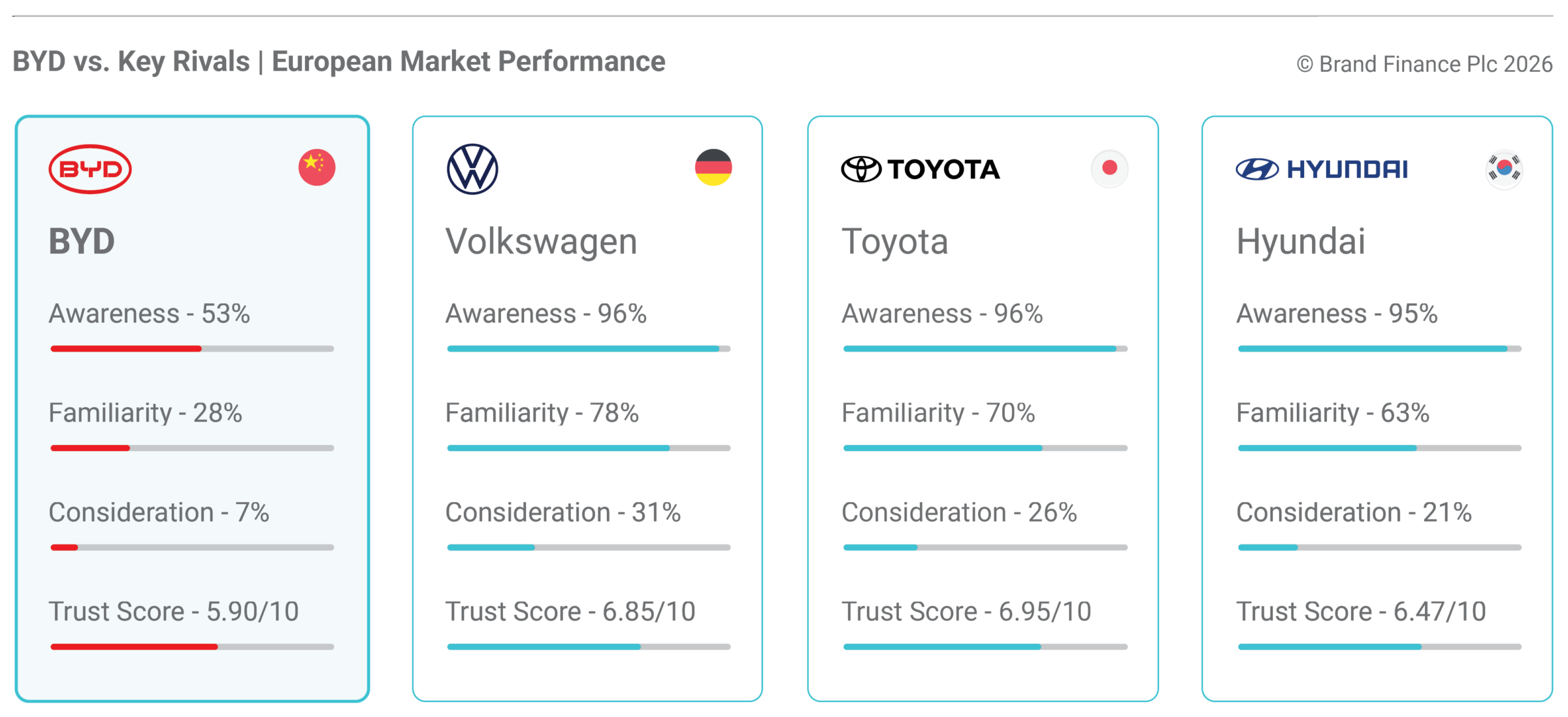
What makes the Chinese brand story genuinely compelling is what happens when European consumers evaluate brands on the attributes that matter most in today’s automotive landscape. On technology, innovation, sustainability and value for money, Chinese brands are already outperforming many established European and global competitors. Keep in mind that while technology leadership and sustainability are weaker driver of consideration, Great value for money is actually the most important and performance entertainment systems is in the top 5.
This is a remarkable achievement for brands that most European consumers have only recently encountered. It suggests that the product story is landing clearly and credibly, even in markets where the brand story is still being written. Chinese automotive manufacturers have not arrived in Europe asking consumers to take a leap of faith. They have arrived with a competitive offering that speaks for itself on some of the key dimension's buyers care about.
BYD leads the charge, with Xiaomi showing a different path
Among Chinese entrants, BYD is the most recognised brand in Europe, with awareness at 53% and consideration at 7% across the markets studied. While this is still below Toyota, Volkswagen and BMW, which record between 96% and 98% awareness, BYD’s growth trajectory is strong, and its EV credentials are becoming increasingly understood by European consumers actively exploring the category.
Xiaomi illustrates a different path to rapid market entry. Already familiar to European consumers through its consumer electronics business, the brand carries over significant equity into its automotive offering rather than starting from zero. In France, Xiaomi records automotive awareness of 71% and consideration of 14%, while in Germany it achieves 67% awareness and 11% consideration. These are levels many legacy automotive brands take years to build, yet Xiaomi is reaching them early by leveraging strength from another sector.
The contrast between BYD and Xiaomi is telling. Both are establishing credible positions in Europe, but through different approaches, one driven by sustained investment and visibility in the automotive space, and the other supported by strong brand equity built outside the sector but more relevant as auto are moving as being “tech on wheels”.
Dominant at home, competitive abroad
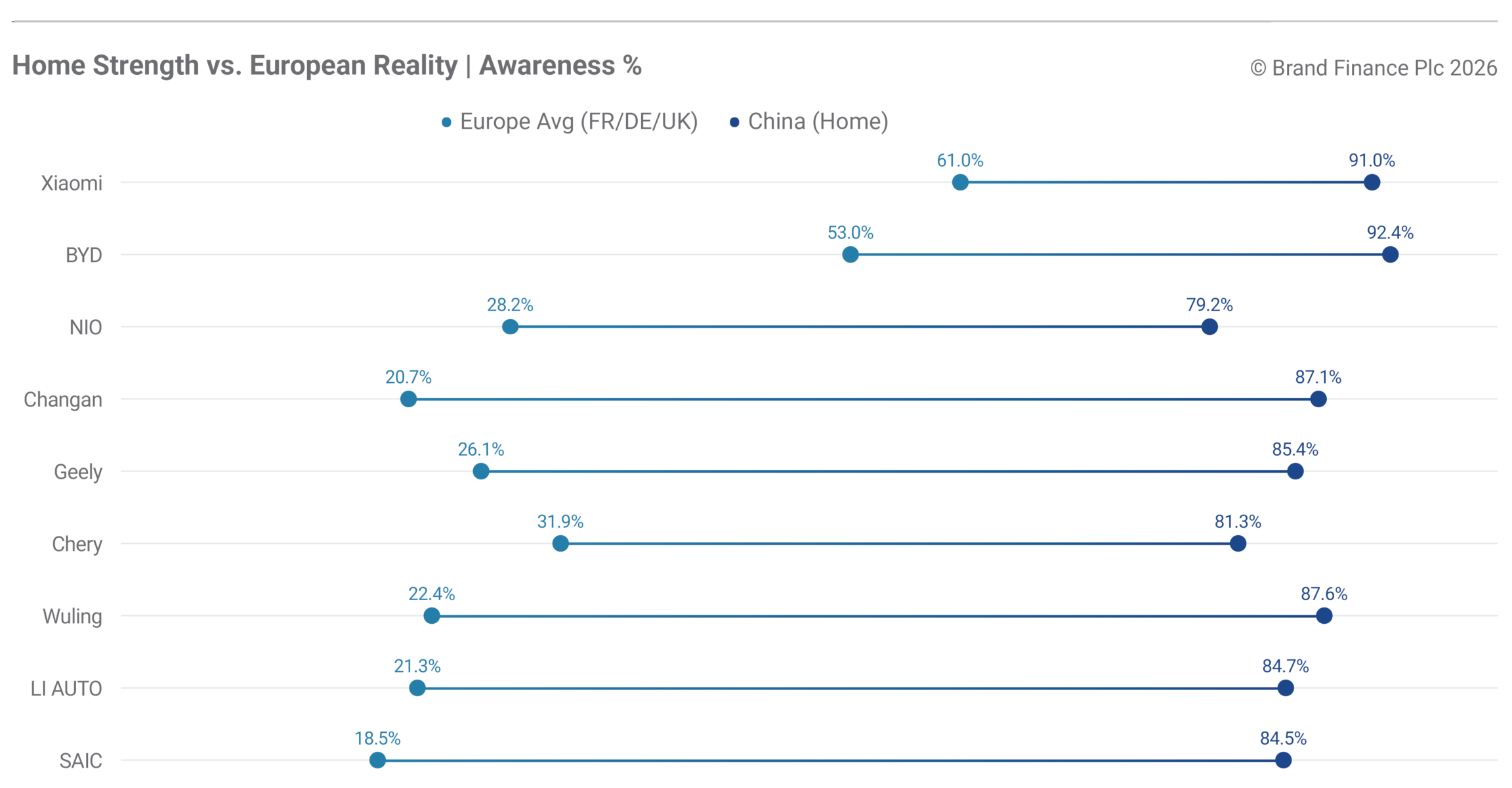
The domestic market further highlights the strength of the underlying proposition. In China, both BYD and Xiaomi record awareness levels of around 91% to 92%, with consideration above 30%, placing them among the most prominent brands in one of the world’s most competitive automotive markets.
Among European markets, the United Kingdom shows the greatest openness to Chinese brands. Consistently across the brands tested, the UK records higher awareness and consideration than France and Germany. Changan achieves 25% awareness in the UK versus 18% in France and 19% in Germany. NIO reaches 29% in the UK versus 23% in France. Wuling records 25% in the UK compared to 18% in Germany.
Germany remains the most challenging market, where strong loyalty to domestic manufacturers and a deep automotive heritage create higher barriers to entry. However, this is a structural rather than permanent condition. Chinese brands are already competitive on the very attributes German consumers value most in their own manufacturers, namely technology and innovation.
Awareness follows reputation, and reputation is already forming
The average trust score for Chinese brands in Europe currently stands at 6.02, compared with 6.63 for German brands. The gap is narrowing and is likely to continue closing as familiarity increases. Trust is not built through marketing alone. It develops through product experience, word of mouth and consistent market presence. Chinese brands already have strong products and are steadily building their presence. Trust is expected to follow.
The dataset behind this analysis includes 203 entries across China, France, Germany and the United Kingdom, covering around 100 unique brands from 15 countries.
The rise of Chinese automotive brands in Europe is not a story of overcoming a credibility gap. It is a story of brands entering the market with strong fundamentals, leading in technology, innovation, sustainability and value for money. The focus now is on building awareness and familiarity to convert that strength into market share. Based on current evidence, they are well positioned to succeed.