




This article was originally published in the Brand Finance Airlines 50 2026.

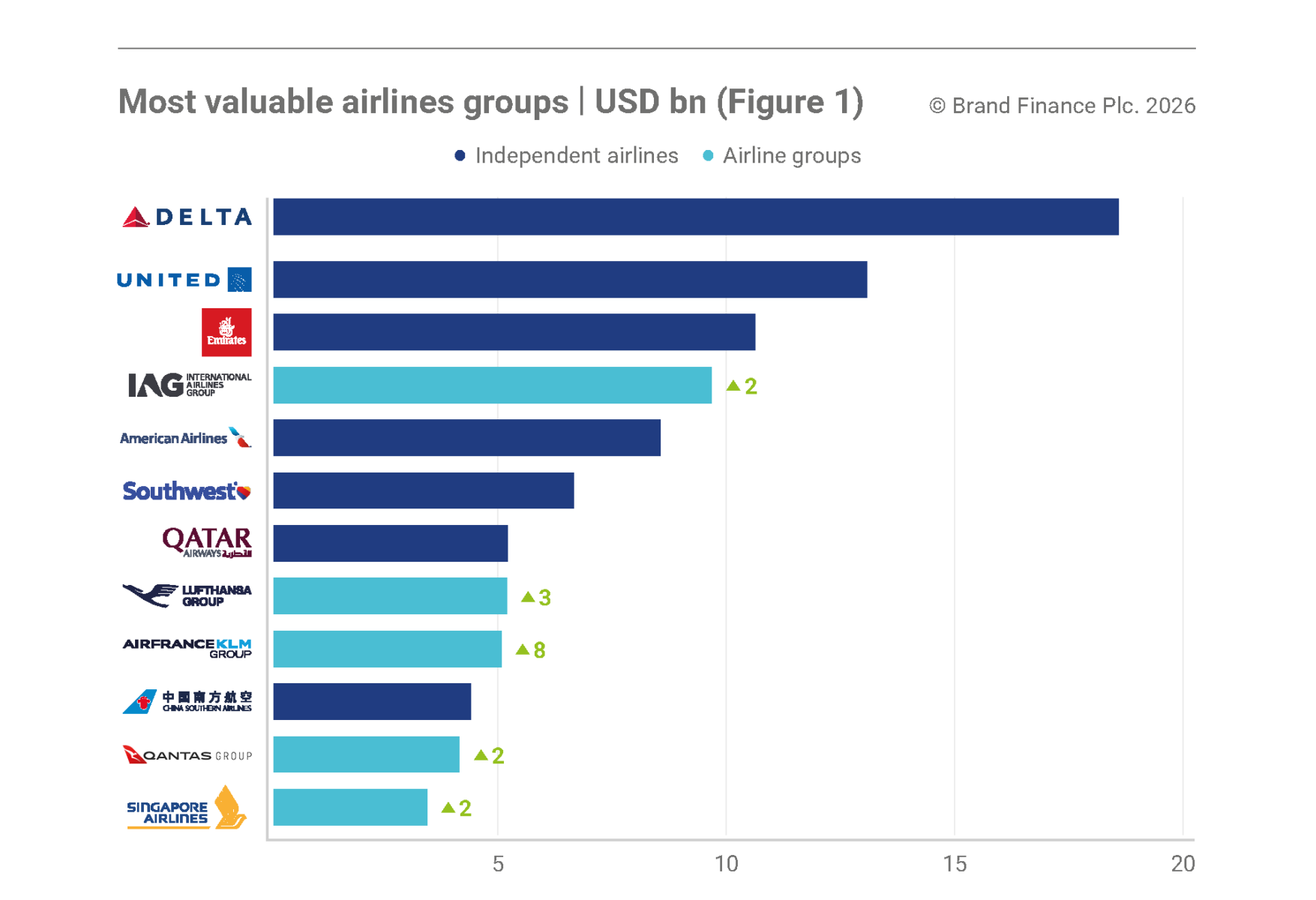
While most airline groups are anchored by a single flagship carrier, their true competitive strength becomes far more apparent when viewed through the lens of total group brand value. This broader perspective reveals how multi-brand portfolios can materially enhance ranking positions, with groups such as Air France-KLM and International Airlines Group (IAG) benefiting significantly from the cumulative strength of their subsidiary brands.
In 2026, this dynamic is particularly evident in Europe, where group structures are not simply a growth strategy but a structural necessity. Legacy carriers such as Lufthansa Group, Air France-KLM, and International Airlines Group operate across highly fragmented markets, shaped by national identity, bilateral agreements, and airport slot constraints. Maintaining multiple brands allows these groups to preserve local relevance while optimising network reach and pricing strategies across distinct customer segments. Full-service carriers coexist with low-cost and hybrid brands, enabling coverage from premium long-haul travel to price-sensitive short-haul demand.
By contrast, in Asia-Pacific, the rationale for multi-brand portfolios is more commercially driven. Groups such as Qantas Group and Singapore Airlines Group leverage brand portfolios to capture structurally different demand segments across a rapidly expanding aviation market. Here, the dual-brand model, typically pairing a premium flagship with a dedicated low-cost carrier, reflects the region’s strong growth in leisure travel and rising middle-class demand. Brands such as Jetstar and Scoot are not just complementary; they are essential growth engines that allow parent groups to scale without diluting the premium positioning of their flagship carriers.
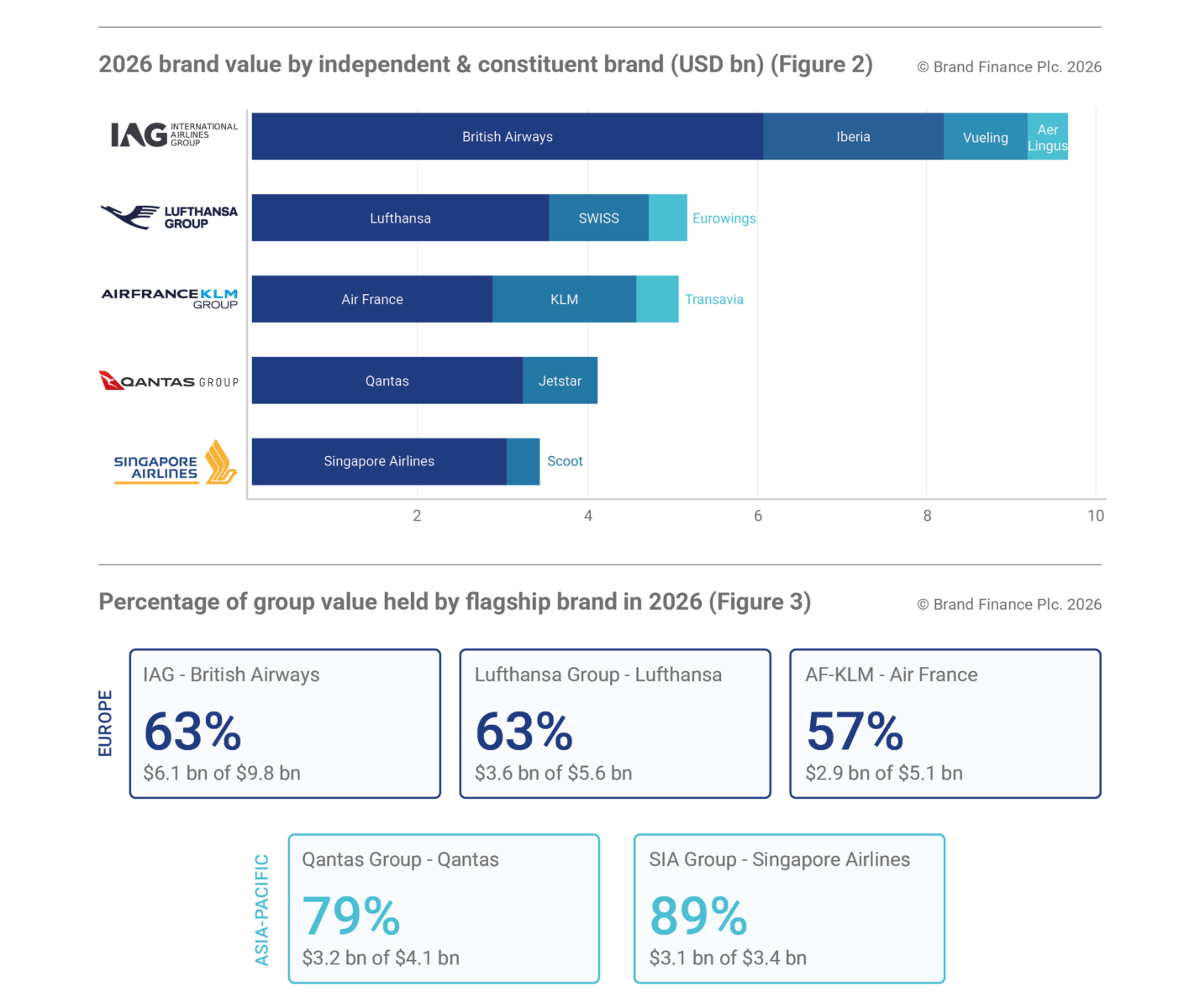
However, despite the presence of multiple brands, most airline groups remain highly concentrated around a single flagship. In 2026, flagship carriers continue to account for a substantial majority of total group brand value, often exceeding 60% and, in some cases, approaching 90%. Singapore Airlines, for example, represents nearly the entire brand value of its group, while Qantas similarly dominates within its portfolio. Even in more diversified groups such as International Airlines Group, British Airways alone contributes over 60% of total group brand value.
The growing importance of brand management
This concentration creates three key risks. First, earnings and perception exposure. Any operational disruption, reputational issue, or decline in customer experience at the flagship level has an amplified impact on total group brand value. Second, limited portfolio leverage. When secondary brands contribute marginally, the group is unable to fully capitalise on different demand segments, particularly in price-sensitive or regional markets. Third, strategic rigidity. A dominant flagship can constrain pricing, innovation, and service experimentation, as changes risk diluting core brand equity. At the same time, there are early signs of a gradual shift. Groups such as Air France-KLM are becoming less concentrated, as brands like KLM and Transavia grow in relative importance. This signals a move towards more balanced portfolios, where value is distributed more evenly across brands rather than anchored to a single entity.
As this transition unfolds, brand management becomes significantly more complex and far more critical. Managing a portfolio of airline brands is not simply about ownership; it is about defining clear roles, maintaining differentiation, and ensuring that each brand contributes meaningfully to the overall strategy. For airline groups, this requires a more deliberate approach to brand architecture. Each brand must have a clearly defined purpose within the portfolio, whether as a premium global carrier, a regional connector, or a low-cost operator. Overlap between brands can lead to internal competition and customer confusion, weakening overall brand equity rather than strengthening it. Equally important is portfolio coherence. While brands must remain distinct, they should still align with the group’s broader values and customer expectations. Inconsistent service standards, fragmented customer journeys, or misaligned value propositions can erode trust at the group level, even if individual brands perform well in isolation.
Another priority is scaling secondary brands strategically. Low-cost and hybrid carriers, such as those within Lufthansa Group or International Airlines Group, are increasingly important for growth drivers. However, their role should extend beyond volume generation. Strengthening their brand equity, improving customer perception, and investing in digital and service innovation can help reduce over-reliance on flagship brands and create a more balanced value distribution. Finally, airline groups must focus on managing brand stretches carefully. As groups expand into new services such as loyalty ecosystems, digital platforms, and ancillary offerings, there is a risk of overextending flagship brands into areas that may not align with their core positioning. Using sub-brands or portfolio brands more effectively can help capture these opportunities without diluting premium equity. Ultimately, the next phase of growth for airline groups will not be driven solely by network expansion or capacity increases, but by how effectively they manage their brand portfolios. Those that can reduce concentration risk, strengthen secondary brands, and build clear, coherent brand architectures will be better positioned to create more resilient and sustainable brand value over time.